Friday, 30 June 2017

A Time to Plant

looking back to November/December 2016:

Our estimable Director of Programs and Training, Patrick, led a couple of permagardening workshops for PC volunteers in 2015, with a view to having his mentor and PC permagardener extraordinaire Peter Jensen visit Namibia from his home in Ethiopia for a master class in 2016.  It wasn't until late November that we finally got to meet Peter, and learn so very much from him.

We started in the classroom, but quickly moved into the literal field.
It was really hot up north in late November and early December, so we tried
to get the physical, outdoor labor done early in the day, and usually failed.

He's an RPCV (Returned PCV) of about 30 years' standing, and he's gardened around the world, adopting sustainable techniques from anywhere he can find them.  I yearn for a chance to get him to Dreamland Garden; I bet he'd have some great ideas.  They've tried a bit of hugelkultur there, and some composting, and both have worked very well.  They need to do more, but wood is hard to come by in a place without trees, and compost takes some creativity in a very dry environment.  (Hugelkultur involves using wood - usually just logs and sticks - in the growing medium to help conserve water.  You throw a few logs on the ground, pile your dirt or sand-and-manure mix on top, and then plant.  The logs absorb water that would otherwise drain into the deep ground, and release it gradually to your plants.  Clever and simple.)


In Ongwadiva, they have grass and trees.
We do not get those where I, and Dreamland Garden, live.

Peter uses lots of mnemonic devices to assist his trainees' learning.  One is CLOSE - he wants community leaders with an eye toward gardening to keep their projects Close, Local, Organic, Small and Easy.  A project that's far from the people operating it, that requires importing foreign or buying synthetic goods, or one that's too large or too complicated to maintain probably won't succeed.  So he urges us to think about all those factors when planning.

Right next to a PCV's on-campus housing

Then there are the Six S's, which come with a warm-up-and-stretch exercise.  These are the critical steps in water management:  Stop, Slow, Sink, Spread, Save and Shade.  In a lot of climates, rain is a seasonal thing - you have rainy season and dry season, and plants can drown in one and wither in the other, so you need to think about how to collect the water and disperse it more gradually than the natural cycle would do.  We built berms and swales, and intercropped both for pest control and to allow taller plants to shade shorter ones.

Here we are Sinking and Spreading in the Shade.

Peter spent a lot of time on soil conditioning, too - we added charcoal, egg shells, coffee grounds, and elephant dung, as well as more conventional ungulate dung, to the sandy-but-okay soil of Ongwadiva.  We double-dug with traditional short hoes; we kept the beds narrow enough for two people to shake hands across them.  We collected brown and green compost from anywhere we saw it on the grounds of the school where we were planting, and built a compost pile for future conditioning.

The completed compost pile, with plastic to help keep it moist in
this arid climate.

Soil amendments from breakfast

We mixed little twigs into the soil, too; mini-hugelkultur.

And, of course, elephant dung.

Double-digging is sometimes called 'bastard trenching' in the UK.
And it's not nearly this hot there.

We also spent time in the classroom, discussing the heartbreaking conditions of malnutrition, and especially the deleterious effect it has on early childhood development.  Stunted growth doesn't just mean a child is shorter than s/he should be, it also means all his or her physical systems - the nervous system, the brain, the heart - aren't as robust as they should be.  Given high levels of poverty in Namibia (masked from international aid organizations by the very high income disparity, so a few very wealthy people skew average income for the whole country), many children here suffer from stunting.

Future nutrition in well-nourished soil, with a layer of pine-needley stuff
to help Shade and reduce evaporation.

Future nutrition in need of immediate resuscitation

Close, local, easy gardens are a great way to provide vitamins and minerals at low cost.  They can also help ameliorate the impact of climate change, and maybe a tiny bit help to slow it down.  Grow local and organic, and you don't have to ship food in from more expensive, more fertile places.

We got us a garden.


Sunday, 11 June 2017

Undocumented

Documenting my experiences in Namibia with photographs is important to me, and invaluable in helping me remember and describe what I've known.  But my camera is bulky, and heavy, and a potential thief-magnet, so I don’t lug it with me everywhere I go.  Thus, much of my quotidian life goes unrecorded, except when I make a special excursion to take pictures of the everyday, like I did with my posts about my typical day and my town.

The evening I happened to have my camera and could record street-corner singers felt a little bit magical, or fated.  Would I have remembered that sublime three minutes without the video?  (It’s not just the video itself, but also the additional effort, the activity, of creating it, that helps fix the moment in my mind.)

I needed a picture of the meatballs to prove to Andy that I'd
made them.  Quite successfully, I'm told.
Recently I had a new batch of shadows come to visit, so I invited Fabiola and Gideon for dinner.  Five of us ate outside, gazing at the Southern Cross and her companions, and a faint glimmer of Milky Way.  (My town is bright with streetlights at night, and there’s one right by my front yard that nullifies much of the Milky Way’s glow.  It's still a lot more glow than I got in suburban DC or Philadelphia.)  Toward the end of the meal, which was a pretty filling pasta with chunky vegetable sauce and meatballs for those who like that sort of thing, I asked Gideon if he would sing in Damara for us.  He did, happily and beautifully.  I sat back, content and comfortable, stuffed with good carbs, pleased with the company, delighted by the music, awed by the constellations above us.  When Gideon finished, I told him about the band I was going to see the next night.

Wakambi are a good drum-bass-guitar combo writing their own songs, with a talented, mixed-race I think singer on that guitar.  There’s a fourth member, I think mixed-race also or maybe Damara, who raps – in Afrikaans.  (Race or color matter; people are too often uncomfortable mixing socially, which I know is common in the US, too.  When I told one (black) colleague I was going to the Desert Tavern to see a band he might like, he immediately, slowly, said, “I don’t want this to sound racist, but...” and I was able to interrupt and tell him he might like Wakambi – as he would almost certainly not like the usually all-white, 70s-English-and-American-cock-rock cover bands that normally play there.)  Afrikaans rapping is good fun, “but what I want to hear is rapping in Damara,” I said.

Gideon immediately broke into a Damara rap.

He really POPPED those clicks and pops, and jerked his hands, arms and head with the rhythm, and even achieved a slightly tough cast on his wonderfully amiable face.  And for a moment I wished for my camera – I could run inside and grab it; ask him to do the rap (which he composed) again – I wanted to document this:  the percussive sound that communicated specific information to only, maybe, two hundred thousand people on earth; the sight of the performance and the stars, my wonky laundry line and the happily rapt audience; the near-perfect temperature and gentle breeze; the smell of basil and onions and mince and colder weather coming; and the feeling – oh, right.  My camera doesn’t have a setting for that.

So the feeling – not quite out-of-body, but certainly elevated, moving toward levitated, hugely conscious of the moment and the many sensory inputs, the grateful-eternally feeling – I tried to trigger a button, or something, in my brain, or somewhere, that would fix that feeling, the memory of this, in my being forever.  I hope it worked.


The next weekend, PCV A. agreed to meet me at Swakop’s swimming beach, the Mole (pronounced like, but emphatically not, the delicious Mexican sauce made with cocoa powder and twelve million variations that I am definitely going to be eating next time I’m in a country with a decent Mexican restaurant).  He would watch my stuff so I could, finally and jubilantly, get right into this ocean and stick my head under.

He fixed himself in the sand, I unslung my sarong, positioned my goggles, and headed in to the wavelets.  As per, the water was delightful on my feet and ankles, etc., and when the shelf dropped abruptly and set me down thigh-deep, that was delightful, too.  Perhaps a bit brisk.  And I took a good inhale, swung my arms in a forward arc, and dove toward the other side of the inlet.

Oh, blessed Tara goddess of mercy, it was cold.  It was skull-cracking, heartbeat-skipping, gasping cold.  Gasping, hearth arrhythmia and swimming are a bad combination, but after what felt like fifteen minutes but was probably about 90 seconds, I’d adjusted and was breast-stroking as strongly as I ever do, and as happily as I ever have.

I made it from one strand to the other and back again in about 20 minutes, and lolled about at the shoreline, letting the sense impressions – mostly emotional; I do love the water – sink in deep.  I also chatted with some local kids who fled shrieking every time a wave washed toward them.  I offered to help them float a bit, but they couldn’t bring themselves to trust.  A large and ludicrously jolly woman in wet shorts and a wide open, sleeveless shirt took up my offer, but clung to my neck in a way that could have drowned us both.  Or me, anyway.  So I moved discreetly west and played with the waves until one aligned and I could body-surf it in zooom and take two palm-loads of gravel at speed but protect my face, and look up to see a police officer in serious confab with the naked-breasted woman.  They walked off the beach together, with two mufti-clad individuals talking vigorously.

A. told me the woman had, while I was on my return journey, sat down next to him and asked if I were his girlfriend.  On his negative, she offered to fill the role, and started building a sand-house where they could live.  He explained he has a girlfriend in America, so she asked if he knew any white men, as she would like a white boyfriend.  He negatived again, the crowd of kids arrived, apparently everyone but A. expressed excited concern that I would drown or was drowning, and as they saw me get close, they headed down to the water’s edge to greet.

This hardly gives you a sense of the thing.
We have no idea what prompted the police presence.  We speculated about her effective shirtlessness, but Himba women go topless here all the time.  Maybe they have an exemption on traditional-culture grounds.  Maybe our woman had bothered someone else – who were the two un-uniformed people? – maybe she just got some encouragement to leave tourists alone.  She did not seem to be under any duress, or unhappy as she walked away.

The swim was blissful; the accoutrements brain-reconfiguring and brand new.  No photos.  I did take a picture of A. at the cafë where I bought him hot tea on his preference instead of the promised beer, but mostly I just have to be certain I glue this one into my cells.


A week earlier, at that same Mole, an Afrikaner couple – 30s or early 40s – shouted at me, “Do you know those men?” pointing at two gracious and dignified older black gents walking near me.  While I was trying to formulate a polite and brief response indicating I do not understand why or how that is any concern of yours, they shouted, “They’re looking at you!  Watch your purse!  They’re looking at you!”  While I was trying to set them on fire telekinetically, one of the men said, with grave simplicity, “We are not thieves,” which apparently prompted the Afrikaner man to offer to fight them both.  I attempted an apology for the entire concept of European heritage, but am not sure it went over really well.  Then I wished them a wonderful day and walked away shuddering.

Incidentally, my purse was tucked deep into my armpit, I was juggling a bit of errant trash I’d scooped from the ocean, my hair was – call it ‘tousled,’ though ‘disastrous’ might be more accurate – my skirt was damped and tucked up into my swimsuit, and quite probably my shirt was wet, too.  Altogether, anyone could be forgiven for outright staring, and maybe contacting that police officer who shepherds unconventionally-dressed women off the beach.  No photos on that one, either.

And no photos this week.  Wednesday evenings are for English Improvement Group.  Usually three or four or five residents gather up with me, and we read a very brief essay together, and discuss it.  One night we listened to Tracy Chapman’s ‘Fast Car,’ and read the lyrics and talked about the story they tell and the language they use to tell it.  When we’d heard it a few times, and read it through, and discussed it a good bit, I played it once more and most of us sang along.  (I chose the song in part because I’ve heard it frequently in Namibia, including coming from a neighbour’s house, but none of the English Improvers were familiar with it.  One called it a country song, because acoustic guitar equals country.)  We watched the first 36 minutes of 'Star Wars' (IV, the first one made) another night, but that did not go as well.  The story and setting were confusing and the actors talked fast, and we didn’t have a script to read.

This week I decided we’d have a song again:  Bonnie Raitt’s ‘Down to You.’  At 16:00, the power failed, and Ritha down the hall told me it was a scheduled outage, town-wide, until 18:00, and the Improvers convene at 17:30.  But the laptop will run for an hour or more on battery, and most people’s phones have flashlights, and I had already printed and photocopied the lyrics, so I toddled home and collected a few headlamps and extra flashlights, and got back too late to grab a vital padlock from Gideon.  We’d have to hold class in my office, which has no lights, instead of Johanna’s, which is bigger and well-lit when there’s power available.  Still fine.

Priscilla, Daphne and Eveline in Johanna's lit office
on a less-dance-y day.
Four people attended (a few checked first), and we listened to the song, read the lyrics, talked about contractions and karma and endearments, and then sang it together at the end.  It’s a four-minute song with about two minutes of singing and then two minutes of Bonnie Raitt working her slide.  So I stood up and said, “Let’s all dance,” and we all did, for two minutes in the dark office with random flashlight and phone-light and headlamp beams providing spots of brightness.  I tried the camera, but it wasn’t interested in the low light and the flash would just have made a false picture by lighting what was dim and weird and silly and improvised.

We danced and laughed in the dark, thinking about slide guitars, what we call our boyfriends and girlfriends, and favourite songs.  And maybe some of them were thinking this was kind of crazy, but of course it wasn’t.  It was just great, and fleeting, but maybe it’s never gone.

PS:  While I composed this essay, at a café near the Mole, I saw a dark fin breach the water and submerge.  I was very sure I saw it, and searched the water for another sighting until I’d started to think I hadn’t, and then I saw it again.  Several times, and a kayak and a motor boat saw it, too, and moved in, and I’m pretty certain I saw a dolphin, in the Mole where dolphins just do not belong, and I stood in the sun scanning the water with my eyes wide and my smile too wide to be really a smile anymore, more like a frozen gasp, and my fingers up in front of my mouth, like a cliché of excitement.  It was gorgeous - and undocumented.

The Mole.  I managed a second swim, dolphin-less, a week after the first.  This was the day after that.

There are a couple of people against the wall on the opposite shore,
just past the left-hand rocks, to give some perspective.

Tuesday, 6 June 2017

It's a Small World, and a Big One

I guess that's kind of the point of the song, right?  It's a great big world if you're trying to walk it, but as you go you'll discover many points of common experience, feeling and understanding with the people who inhabit it.

Tina and Eric are two of the people inhabiting my corner of the world, as Peace Corps volunteers in Namibia.  I love their blog, Littlebackpackbigworld, which includes posts on longboard skateboarding the mean streets of the Namib Desert, how to be a vegan in a seriously meat-oriented country (including how to acquire and cook these amazing mushrooms the size of your head), and Tina's piece on four things she has learned about Namibia, including that people really love meat here, that alcoholism is a big problem with a complex past, that many children are taught not to question what they're told, and that wealth disparity (as of 2000, the highest wealth disparity in the world; the US was fifth but has probably moved up since) is a source of concern.  I used this piece in our English Improvement group/club two weeks ago, when 2017's shadows were visiting, and it prompted an excellent, wide-ranging discussion.

Check them out for a fresh perspective on travel, Namibia, Peace Corps, cooking and eating, meditation and more.

Monday, 5 June 2017

More Thanks; More Giving

looking back to November 2016:

Thanksgiving has always been one of my very favorite holidays, and I cannot remember celebrating the holiday without a whole lot of joy and appreciation.  Thanksgiving 2015, when four PC friends visited and cooked up storms in my suddenly-small kitchen, was a great one.  (Four and a half, really, as S. showed up on the Sunday morning, made us pancakes and vanished.)

Anneline, Dennis and Silas posed for me on the actual day for a Facebook post.
The sign they're holding is one I put up on my office door to try to describe
Thanksgiving to Namibian visitors.  It includes the fact that about 50 million
people live in poverty in the USA, so many more-fortunate folks help out at
soup kitchens and food pantries as part of their holiday.  Lots of people outside
the US don't know that there are many poor people in our country.


But there wasn't a brew pub in Swakop in 2015, and by 2016 there was.  So a group consensus emerged that we'd celebrate there instead, and a huge number of volunteers converged on the coast with recipes and good cold cash in hand, for a Saturday-after-the-real-holiday-which-we-don't-get-here fiesta.

But before all that could happen, I was walking home Friday night and got a phone call from a number my phone didn't know, and when I answered a guttural voice said, "Hello, this is Hans.  D. in Opuwo said we could stay with you tonight," and I thought, 'No way would D. give my number to strangers without telling me he'd done so... but..."  So I turned 'round and went to my temporary roommate H's office, as D. is her boyfriend.  She phoned him and confirmed that he had given my number to a couple strangers, and they seemed like legit Austrian couchsurfers, but he hadn't told them they could stay at my house - just that maybe they could.  It being a season of sharing, and me being a person who wouldn't turn them away at any time, we flung wide the gates.  Austria had given them the opportunity to quit their jobs and collect an unemployment-type stipend as long as they could claim they were engaged in educational pursuits, so they took a few courses back home and then flew to interesting places and couch-surfed.  They were quite bummed that the year would be up soon, and they would have to get jobs again.

Two Austrians whose names I've forgotten (and they could very easily just
give fakes ones, anyway) and H., snacking before falling asleep on the couch. 
The Austrians, that is; H. had a bed and her own room.

And they took a long time to leave on Saturday morning, but eventually H. and I made it to Swakop.  There, we had two kitchens at our disposal: one at S's, and the other at G. and N's, who also have a braai stand on which to make roosterbrood.  Nonetheless, there were too many cooks for the kitchens, so I did not contribute anything culinary.  Two of the cooks are vegan, and presented many tasty options over and beyond the turkey that G. and N. had scared up from somewhere.  There may have been dried cranberries in one of the side dishes, too.  Definitely there was J's specialty mulled wine, and A's awesome mashed spuds, which is about all I need for a happy life.  Y. had the good sense to pack a generous helping of leftovers that she kindly shared with those of us hiking up to Otjiwaronjo the next day for a permagardening master class.  Fab!

J. mulling

A. preparing to mash

Vegans in Namibia!  E. grew up in the town next to where I grew up, though
about ten years after I'd left.

Some of us, eating.


Thanksgiving food is really good, but the friends, and family if you can get them, are really the best part.  You probably know that.

S. and her roommate/landlady generously let us stay at their place, a former
B&B that now supports r/l's rescue dog and cat habit.  It is so great to hang
out with friendly, clean, loved domestic dogs.  Billie, one whose name I never
could get, and Caper.

Wednesday, 31 May 2017

Another Atypical Day

looking back to November 2016:

Weird things happen everywhere we go, right?  And some days just get a bit weirder.  There was nothing exceptionally weird about the 19th of November in 2016 in Swakopmund, but the number of interesting things I saw in the span of a few hours was... unusual.  And however often one sees men dressed as fairies in Boston and etc., in Swakop it's about a million kilometers from the norm.  (There was a gorgeous, small, slender, darkish-skinned man who dressed as Tinkerbell in Boston in the mid-80s and pinned condoms to the reeds where a lot of casual sexual contact occurred, as people were just starting to become terrified by AIDS, but still resisted safer sex practices.)

As I type this up in May, there are no flamingos at the Swakop lagoon.
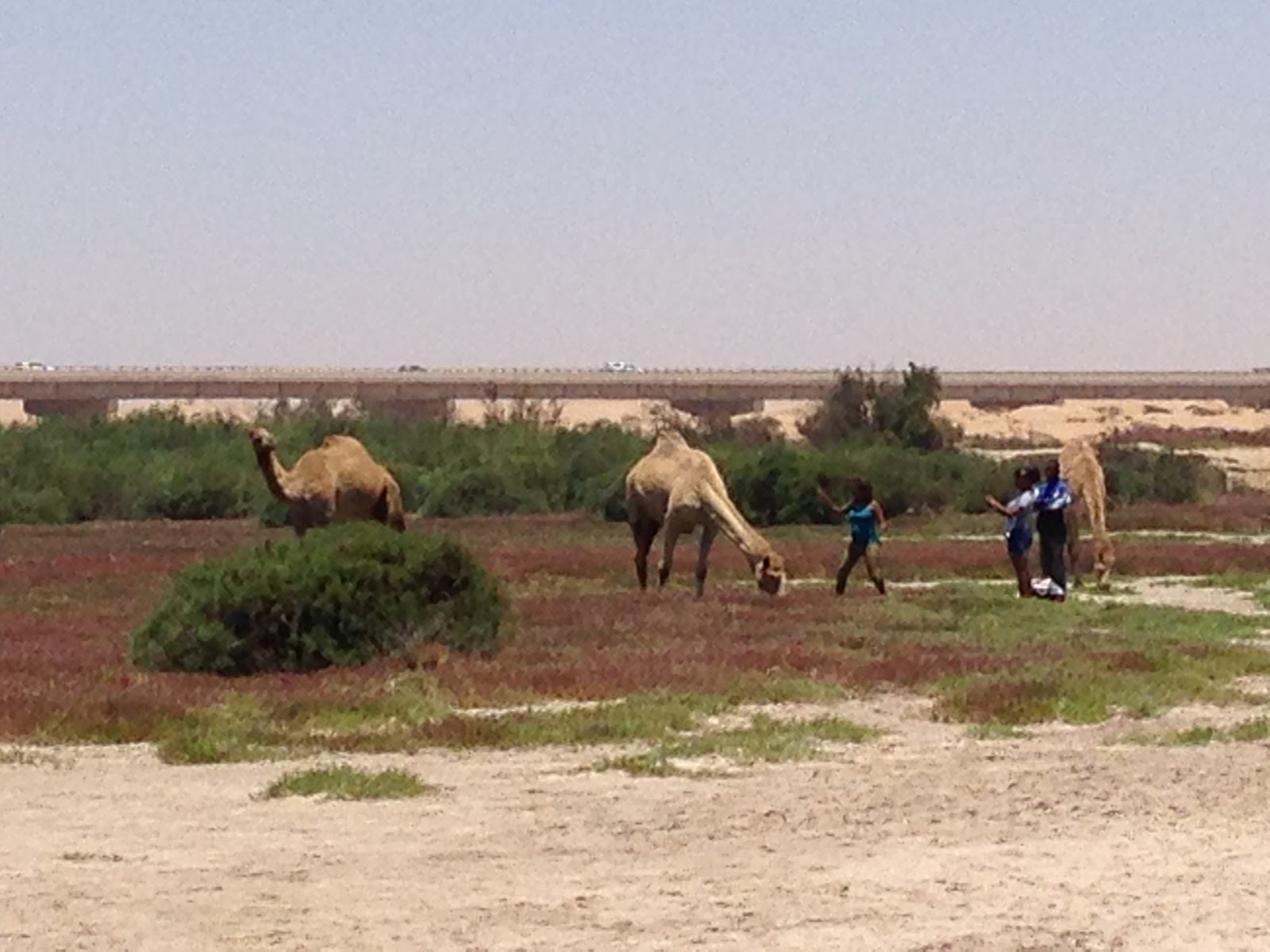
Plenty in Walvis Bay.  But I need them in Swakop.  Note camels in background.

I love them so.  The colors, the grace, the very weird profile in flight.
They may actually be dromedaries.  These Namibian tourists are braver than I.

Camels, and probably dromedaries, bite and spit.


No idea what the story is on this guy, who was with several friends.

I saw him again, hours later, at the fancy hotel on the other end of the beach.

I see more dead seals than live, especially right up on the sand like this.

Pelicans are more at home in Walvis, but today there was one on the aquarium.

Fun!

Tuesday, 30 May 2017

Planning and Training

looking back to November 2016:

I wrote about the Ûiba Ôas Crystals Market about a year ago, which was about a year after I first visited and started working with the miners and sellers of that group.  They have always impressed me, and my respect and affection for them continues to grow.  Their lovely market has great potential to evolve and strengthen, to enrich their lives, their families' opportunities and Namibia's global reputation.

Also, they're fun.  So having four members of their leadership team visit me at the office for a planning session, with two staying over for some training, was great.

Selma brought her daughter, about six months old.  Patricia was about five
months pregnant.  Nelson was training in part to cover her maternity leave.


We had done a SWOT (Strengths, Weaknesses, Opportunities and Threats) analysis for their co-op back in the winter of 2015, shortly after I arrived and started work.  We started from that base for this training session, adding in some new ideas and issues that have arisen since.  You can imagine that it's not always easy keeping fifty-some people with different interests and needs working together well in a business setting, but they usually manage quite admirably.  We came up with an action plan, much of it concerning marketing the market more aggressively, and sent Gabriël and Selma back home, while Patricia and Nelson headed for the Town Council's bungalows for the night.  Patricia phoned me from her bungalow later that evening to report the electricity didn't work and neither did the lock, and she was locked in.  I contacted a friend who works for the Council, and she forwarded the message to the maintenance staff, who got everything sorted.  Whew.


Baby, Selma, Gabriël, Patricia, Nelson and my boss, Lysias.


On day two, Patricia and Nelson worked on their Word and Excel skills.  They both have basics, but wanted to learn things like tables in Word and sorting and using formulas in Excel.  They were really excited to see me do those tasks, and then to do them themselves.  Great fun to teach.  We also reviewed the market's Facebook presence and website, and they posted text and a photo to Facebook.  They aren't able to do that regularly as they often don't have money to pay for data plans, so their internet access is limited.  We're working on it.

Extremely rare photo of Patricia sharing her gorgeous smile with the camera.

Namibia's Social Security Commission provided us with the funds for the training, including money for transport, accommodations and meals.  I made the two morning tea breaks:  sandwiches, cookies, tea (donated kindly if unwittingly by K. in Sarasota; thanks!) and coffee.  The first morning, when there were four of them for teatime, I brought about 250 grams (half a pound; one cup) of white sugar to sweeten the tea or coffee.  They used it all and I had to go borrow more from Silas!  It's quick, cheap calories, and people eat a lot of it here.

Nelson has about a million Facebook friends, though he's not often on it.

Please Like the market on Facebook, and if you visit Namibia, or if you live here, make sure to stop.  They've got beautiful wares, and the people are well worth any support you can offer.

Monday, 29 May 2017

Vacation, Peace Corps 'Style'

looking back to October 2016:

Since I was traveling a significant distance to collaborate with A. on his business-skills workshop, and help celebrate his birthday, I thought it made entire sense to visit two other PCV friends who are up in the northern stretch of the country and check out their work and homes.  So instead of heading south toward home when I left Mpungu, I headed north, toward M.

M. lives in a small village - smaller than Mpungu by a bit - on the Kavango River, a gosh-darn perennial river.  She's a community-health volunteer, assigned to the village clinic, where her job description is pretty open-ended.  She lives with a local family in their compound, which consists of a modern concrete home built by the government for the family patriarch, who participated in the fight for independence from South Africa in the 70s and 80s.  It has electricity and indoor plumbing, but the plumbing is not connected to the local water system, so they still get water from an outdoor tap and bring it in to the sinks and bathtub.

The modern house, with some decorative landscaping.


That patriarch died a few months after M. arrived in the village, and now one of his daughters lives in the house.  The other daughters, and various family members, live in traditional huts in the compound.  Their husbands leave the village for weeks and months at a time, finding work on farms or at mines.  M. has her own one-room rondavel with a thatched roof and a shower in the back, with a bit of curtain for privacy.  She uses a latrine about 10-12 metres from her rondavel, which is in its own little hut, with no roof.  The latrine itself is painted black, so when it spends a day in the bright, direct sunlight, it gets pretty toasty on the buttocks.

The latrine


She has electricity that powers a mini-fridge in the hut and a hot plate, but does most of her cooking in a pot on an open fire in the compound's open-sided kitchen hut.  Also, the electricity runs out about half to three-quarters of the way through a typical month, and she does without.  (There's a lot of carpe-ing diems in rural communities here, as I believe is typical globally.  Somehow, even though most material resources are scarce, people don't make the choice to conserve them -- blowing the monthly paycheck in a few days is commonplace.)  We didn't have electricity when I visited, but with fires for cooking, a hot hot sun for heating shower water, and a solar lamp and a couple headlamps for light, we really didn't need it.

M's hut; B. is just visiting.  On the right is the shower entrance, under a papaya tree.


I got to visit the clinic where M's boss works, and stand in the air-conditioned medicines room.  So nice!  We also met with the secondary school's Garden Club, which is developing a community garden with support from M. and all her good Peace Corps training in permagardening, and M. filled me in on her fundraising campaign to enable the purchase of dozens of solar lights for local families.  It was very successful, and especially when the days get short in winter, a solar light can be a rich blessing for a kid who wants to study and do homework to improve his or her test results.

B. spends a lot of time on condom demonstrations, so double-digging
the community garden with M. on a burning-hot day makes a nice break.

PCV B. visited us one day and helped work in the garden, and we all went down to the river for a picnic, eating up the cheese I'd brought that really doesn't do well in a powerless refrigerator.  We did not see either hippos or crocodiles, and thank goodness for none of the latter, though the former kill more people.  We did see cows.  And we did move very, very slowly:  these were three of the hottest days I have ever spent anywhere.  Thank goodness we could sleep outside.  That part, and hearing M's delight in her neighbors and project,  were the best things about this most excellent visit.

The river; cows on the other side, in the shade.

Cows headed for shade, as are the people.

Our sleep shelter!  We brought M's mattress out, and hung the mosquito net
more to keep out snakes, and by morning we'd need to pull a bit of sleeping
bag over some part of ourselves for a warmth we would not need a few hours
later, when the heat got to full-on debilitating.  And it's only October!


Then I got in a combi and headed to Rundu, Namibia's second- or third-largest city, where I spent a few hours wandering the town of 60,000 (as of 2011; it's probably grown a lot since the census), which was mostly hot and dusty, until a reasonable hour to go sit at a fancy tourist lodge over the RIVER! and have some noodles and watch for hippos that did not appear.  There were people going in and out of the river, though; not everyone shares my crocodile aversion.


The Kavango River, looking east toward M's distant village.


And west toward the, y'know -- sunset.

Off to V's the next day, west and a bit south into the most densely-populated part of Namibia.  Her town, Oshakati, isn't officially one of the largest, but paired with Ondangwa and Ongwadiva, its two neighbors, it makes a formidable semi-metropolitan stretch of strip malls and highly variated housing.  V. is a community economic development volunteer, working in an office coordinating the activity of a dozen or so solar-light salespeople.  Her non-profit, Elephant Energy, provides lights and radios that run on solar power and enable cell-phone charging.  She also undertakes secondary projects, including assisting with computer-literacy classes and supporting a 'soup kitchen' for orphans and vulnerable children.  I got to attend both, and see two very different sides of Oshakati.

The kids mostly segregated themselves by sex to eat their rice and chicken.

Boys cleaning is not an everyday sight.  Kudos to the soup kitchen.

This is the back side of Oshakati, away from the main road with its shops
and denser neighborhoods.


V. has a modern house in a modern compound, and a lot of great friends in her area.   It was invaluable to me, for my Peace Corps experience, to spend a few days getting a sense of the very different ways volunteers live and work.  I brought, as one does, plenty of groceries to my two kind hostesses, but I think I'll say thank you once again to both of them.  I'm so pleased to have been welcomed generously into these (very different) homes.


There are cows in Oshakati, too.
This late in dry season, they get a bit ribby.


PS:  All the many hikes involved in this journey were hot and boring and moderately uncomfortable and relatively safe.  Yay!  And I got to do some laundry in Mpungu, so I wasn't impossibly sticky and rumpled by the time I got to Oshakati.  So I was stylin', more or less.

Wednesday, 24 May 2017

Party in Mpungu

looking back to October 2016:

A. timed his workshop, fortuitously, with a marathon in Swakopmund and... his birthday!  He's also a great cook every day, and M. and Y. are not bad with a spatula, either, which, combined with the success of our workshop and the dramatic change in landscape for me, made for a stellar visit.

A.'s breakfasts are some of the highlights of my Peace Corps service.
 

I live in a town of concrete homes, purpose-built for the men who worked the mines and their families (the mining concern, in 1970s and 80s apartheid, was trying to build a 'non-racial' company, which is kind of cool though of course one wonders how the white men in charge defined 'non-racial' in both their heads and their hidden-most hearts), and they all have electricity and water available.  Only people who can pay for electricity and water can avail themselves of such, of course, but most people here swing it.

The compound has cold running water and electricity most of the time.


Mpungu was settled naturally, by herders from the Kavango tribe.  Most of the population of this region, also called Kavongo (for political administrative purposes, there are two regions:  Kavango West, where Mpungu is, and Kavongo East), lives in the northern stretch of the territory, along the Kavongo River, which is a PERENNIAL river.  That's very rare around here; most rivers are ephemeral, and show usually just as depressions in the earth, filling only in a serious rainy season.  There are a few other perennial rivers in the north, kinda-sorta connecting with the Kavongo (Zambezi, Chobe and Kunene, which got dammed years ago so a large part of its flow is underground now), and then the only other perennial river in Namibia is way south, the Orange River.

It takes a lot of wet (relatively) to keep the country this green.


So a lot of Kavongo people fish and grow crops with river water and stuff like that.  But not in Mpungu!  The village is about 25km from the river, so folks stick to cows and goats and maybe a sheep or two, plus perhaps a spot of gardening.  It's a tiny town, with a clinic and a few small shops, a post office and primary school and a handful or two of shebeens, which often double as shops.  If you need serious groceries, or a bank (the post office provides some banking services), or a secondary school, you have to head those 25km north to Nkurenkuru.  We stopped in Tsumeb on the way into town and picked up supplies, and then M. showed up carrying everything necessary for a Diwali feast, and Y. was packing some birthday surprises, so we were in good shape.

Getting a group together is a good excuse to fuss around with pizza-making.


Mostly we worked on our workshop, and talked about what we'd do the next day, and sat by one of the shops to offer business advice if anyone wanted.  We cooked and cleaned and at some point did some laundry in A's family's semi-automatic washing machine.  Walking to and from the constituency office where we held the workshop took some time and offered views of all those trees, and a decent workout through the deep sand that subs for dirt in much of Namibia, and a chance to make up horror movies in which we might, unknowingly, be acting.  Just hanging around the compound was a thrill; it's so very different from my town and the tourist hotbed of Swakopmund, where I do my big shopping once or twice a month.

And sunset watching, of course.


At some point the three of them did a spate of interval training.  We celebrated A's birthday with a song from the workshop participants in the morning, and a man-bonding experience at the shop/shebeen for M. and A. while Y. and I (but mostly Y.) concocted white-chocolate chip and macadamia cookies, which she knew A. had been craving.  She had the chips shipped in from the US.  I think white chocolate is an abomination against nature, but those cookies were delicious.  And one night A's Kenyan colleague's wife had us all over to dinner.  That was one of the best meals I have ever eaten in my life.  The pumpkin dish!  Eish!!

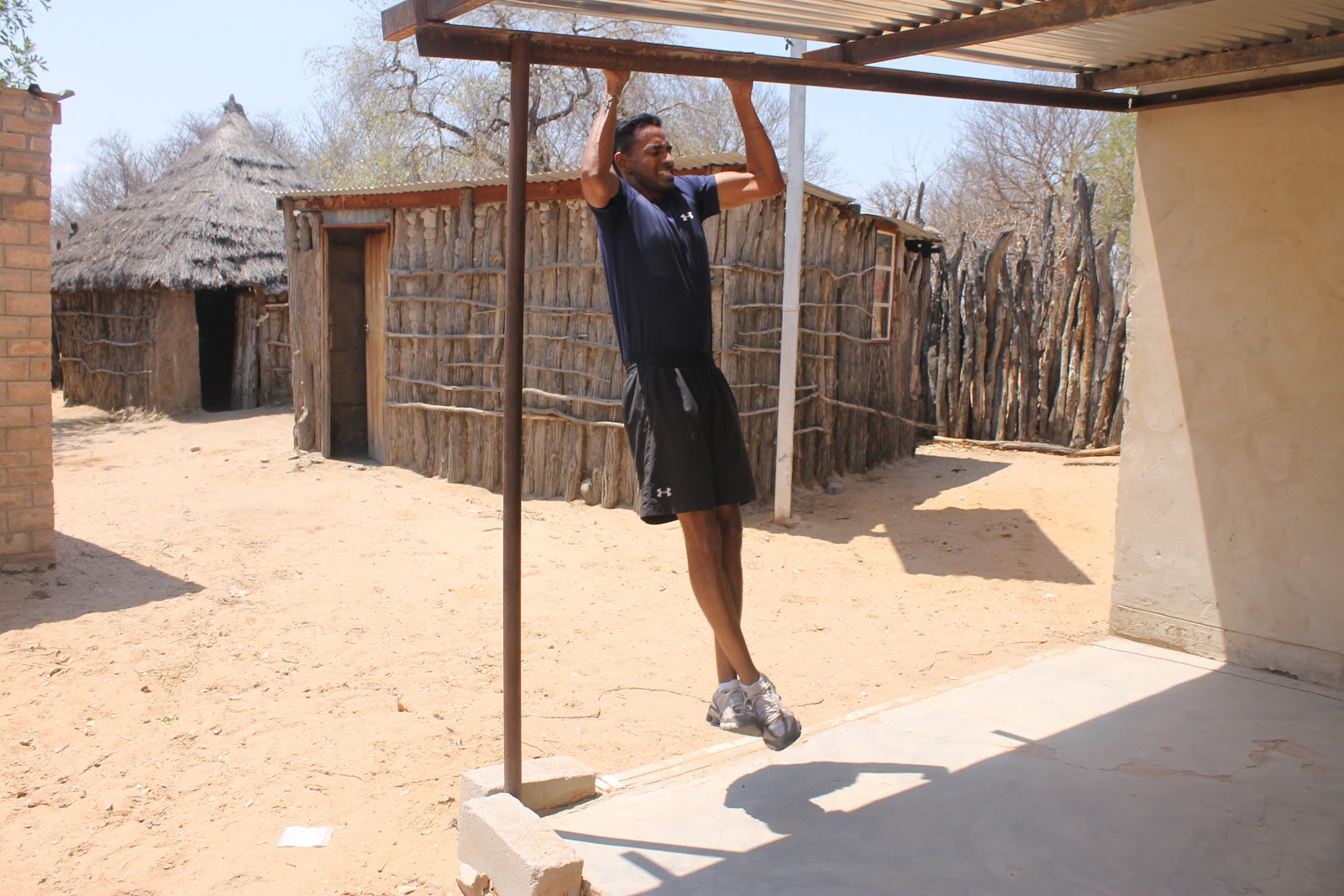
The chin-up station.  M. was worried by significant weight-loss in his first
six months in Namibia; I offered tips for keeping the pounds on.


On the Saturday night, we had a bit of a bacchanal at a local shebeen, with help from Mpungu's PC teacher volunteer and many locals.  The Kenyans gave A. a kind of cloak that may be Masai; he loved it.  Kept stroking it.  It's really meaningful, somehow, when your village friends show an overt sign of respect or appreciation like that.

Birthday card, cooky and embraces


Bush beer, Saturday afternoon warm-up


Pre-Kenyan shebeen time

I think not usually worn with a t-shirt, but that's kind of A's thing.


I left hoping to go back, but it looks like that won't happen.  Maybe someday.  Mpungu is really, really different from my home, and I'm so glad to have experienced it.  And as I waited by the car for Tate Joseph to give us a ride to the hike point, he gripped me by my meaty upper arm and told me, "You are fat, Frede," in an admiring tone, with a warm smile.  It's a compliment.  It really is a compliment.  I know it's a compliment.  Nonetheless, I couldn't get to, "Thank you," and had to settle for (an only-slightly-rueful), "Yes.  I am fat."

And here's a cool flowering plant in front of the stockade-style fence.