Monday, 22 February 2016

Sunsets of Namibia Indeed

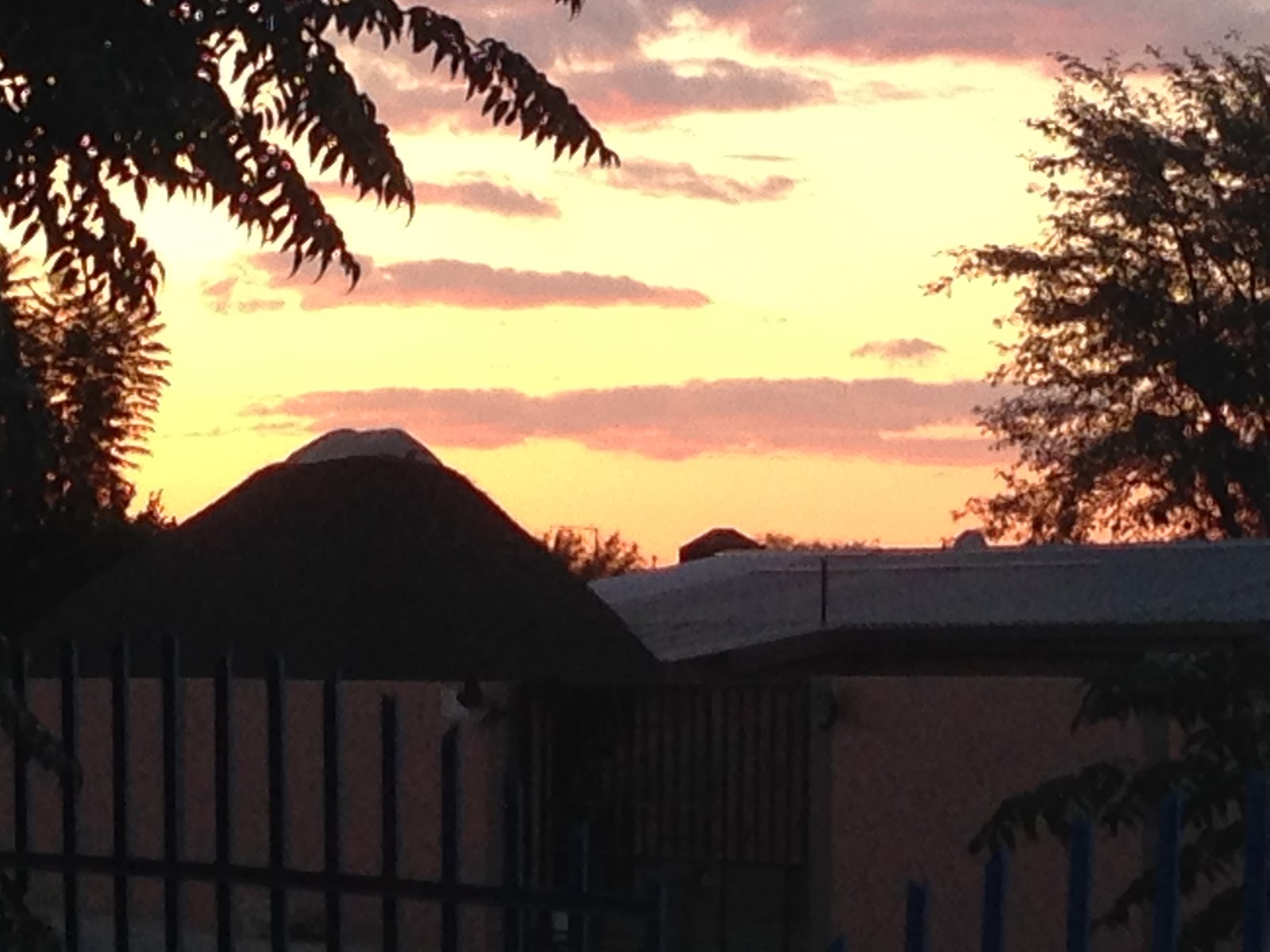
Sunday is often laundry day at home; yesterday I did seven tubs of wash and rinse.  When I stepped outside about 19h30 as we say here, or 7:30pm as I once called it, to bring in the last of the drying, this is what I saw:


Now I realize this may be a quotidian sight for plenty of people in the developed world - Scarlett O'Hara, for instance, and those of you in Montana, maybe, or the higher-rent neighborhoods of the Bay Area (though I suppose you wouldn't get the wonky laundry line in most high-rent neighborhoods), or England's West Country or wherever, but for me...  Not something I'm used to seeing of an evening in the mid-Atlantic suburbs.  Pretty sweet.

Friday, 19 February 2016

Special Day: Handover Ceremonies

Looking back to August 2015:


In 2013, Rössing Foundation supported Dreamland Garden and the Ûiba Ôas Crystals Market, both in the Erongo Region of Namibia, to apply for and win a grant from Namibia's Social Security Commission Development Fund.  The SSC is similar to the US version; employed people pay a small portion of their salaries, and employers pay a small portion of their payroll, into an account that pays out on retirement or in case of disability.  In Namibia, SSC also provides financial support to women on maternity leave, as that's not typically covered by employers.

The SSC also has a mandate to support employment creation, and the Development Fund grants are directed toward that effort.  Thanks to a thorough and well-development application, the Garden/Market won the 2013 grant, two years of financial assistance for identified needs to make the business more robust and sustainable.  The Garden was able to pay for construction of a greenhouse to provide shade and wind protection for its produce, as well as some tools and equipment for expansion and a solar-powered automatic irrigation system.  The Market got a machine for cutting and polishing stones and crystals, and some more of the toilet blocks that its target market - tourists - values so highly.

On the 18th of August 2015, the grants officially closed and the resources they provided for the two projects were officially handed over to the project owners.  There was a great deal of pomp and ceremony attached to the events, as is the norm for official occasions here.


We started at the Dreamland Garden in Arandis, arranging chairs and head tables.  The gardeners were gussied up in their best duds -- no overalls today!  (Overalls here are not what they are in the US -- just a work uniform of poly-blend trousers and long-sleeved shirt/jacket top, often with reflective safety stripes somewhere.) 


Gardeners, gussied.


The dignitaries arrived, including the governor of the Erongo region, the mayor of Arandis, a couple of town councillors, an executive officer of the SSC, the managing director of Rössing Uranium and the executive director of Rössing Foundation.  Whew.  That's some star power.


His Worship the mayor wears an impressive badge of office.


We open ceremonies like this with a prayer, and usually with some kind of cultural performance.  In this case, three of the gardeners sang -- beautifully.  Then we toured the garden, briefly, and head gardener Elizabeth explained about the soil they use, the water-conservation techniques they employ, and the vegetables they grow -- mostly spinach, lettuce, peppers, tomatoes and parsley.


Praise music, in Kavango.


Then we had speeches -- five of them. As is the protocol, each speaker thanked each of the other speakers, plus a non-speaking dignitary or two, plus a specific group or two or three ("all councillors", "the Dreamland Garden team", "members of the media"), plus the generic "honored guests," and then says, "The protocol is observed." I don't know whence this protocol stems.

Elizabeth began her speech by saying, "Pando kanomvenye maweesa tampandura. I say to each of you, Welcome, and thank you for being here. I spoke first in my mother language, Kavongo, because that is the language I use most when I speak to the plants. Be certain that, like all good Namibians, they also like to hear English – and Oshiwambo, Damara-Nama, Afrikaans, Otjiherero and many others!" She was nervous about speaking when we first discussed it, but she aced it like a born public speaker.


"Growing anything in the desert is not an easy task but a challenge!"

After the speeches, we stepped outside and the governor and SSC officer formally handed the keys to the greenhouse to Elizabeth and her fellow gardeners. 

This is why it's called a 'handover.'

We raced away to Mummy's Restaurant for lunch, and then piled back into cars to race east toward the Ûiba Ôas Crystals Market, and did much the same thing again.

My boss & avid photographer; RUL MD, RF ED, SSC EO, and RUL GM

Damaras dancing


This time the cultural performance was Damara singing and dancing, by the members of the market co-op.  And the first speech was by co-op chairperson Diana, who gave her many thanks and then said, "I am pleased to greet you, and to welcome you all in the name of rural development. I may confess, though, that most days I myself, like so many of my brothers and sisters here, I would rather be out there, in the field, prospecting and mining. This is the work I know well, and love.

"My grandmother was a miner. For many decades, she worked with a hammer and chisel on and around Spitzkoppe, bringing beautiful gems and crystals from the rocks and the earth. I think of her often as I work, carrying on this tradition of our people.
"I think of her, too, and a hundred years of small-scale miners, when I stand in the stalls here and greet tourists who ask, Is it really Mother Nature who is doing this?  Even without cutting, or polishing, our stones are beautiful.  Of course, we are all accustomed to the many beauties of our Namibia.  But ladies and gentlemen, for we who stand in this wonderful market, sharing what nature has to show with people from Windhoek, from the north, from many parts of Africa, and from Europe, the Americas, Asia and the Pacific -- our work is an honor, and a joy."


Everyone applauded spontaneously when Diana said, "We are ambitious."
After the remaining speeches, the grand finale was a ribbon-cutting on the cutting-and-polishing workshop, and a demonstration of the whizz-bang new cutting-and-polishing machine.  There was also food (a fancy ceremony like this is a great excuse to feed a lot of people who don't see many calories in a typical day), and then a bit of dancing amongst us hoi polloi whilst the dignitaries departed.  I got to quick-step around the market with a couple of folks I hadn't met before; we observed the heck out of that protocol.

I couldn't get close enough to get a good shot of the ribbon-cutters...

Many of us did not fit into the cutting-and-polishing workshop for the demo.

Congratulations to Petra, Rössing, and all the gardeners and miners who worked hard to make this day happen.  There was a lot of work before the celebration could occur.


Congratulations, too, to the Ûiba Ôas Aqua-Stars, who placed second in the previous week's soccer tournament.  Note their awesome hair-shavings.  The 'aqua' in their name is for aquamarines, by the way -- there's not enough water around here that they can spare any for sports-team names.

Monday, 8 February 2016

A Typical Day


So here's what I do on a typical day as a PCV in a small town in the Namib Desert:


I wake up and say good morning to K&C's monkey from La Sandia.


Then I wash yesterday's socks and myself.


Breakfast is usually corn flakes, sometimes with a banana.


I dress and take my anti-malarial doxy and a vitamin pill.


Then I walk to work - ten minutes or so.


Along the way I may run into this nice ol' guy...


and offer a snack (thanks, M!) or pats.  He loves pats, but maybe snacks more.


At the office...


I say, "!Gai /goas" to Helena...


And, "Goie more" to Ester in the senior library.


Then I head for my office and log in to the network.


Most of my work is research and writing - letters, grant applications - and preparing for English classes and business classes I hope to commence teaching in March.  I also meet with a few people each week who are looking for ideas, advice or assistance for their small businesses.  I expect that will pick up once the classes begin.  I have to remember to get up and stretch at some point, or I'd spend most of each day just sitting in my desk chair.


In the afternoon some kids might come by and color.  Thanks, M!

My bulletin board is a lot fuller now
than it was in August, when I took this photo.


And walk past this de-commissioned ore truck as I head back to the house.


Collect my toasty warm and thorougly-dry socks from the line...

Depending on the season, I may find dead flies on the windowsill at home.


I try to get some exercise before supper, or maybe after according to day-length
and hunger levels.  Noodles and veg; that's pretty typical.  Maybe more often
rice pilaf with lentils and veg or fried rice with veg and an egg.


Friends and family join me - in photos - at supper.


A bath as needed, and back to bed.


Friday, 29 January 2016

Stretch

My yoga practice is not the most advanced.  I do a sun salute most mornings, and have done for decades.  In the 1990s and early 00s I took yoga classes once or twice a week when I could find them for cheap (thank you, HMO!), but when I moved to DC I never got myself yoga-organized.  However, a lot of my fellow PCVs are fairly advanced practitioners, and they have kindly shared videos and podcasts, so I can do a structured routine a few evenings a week.  I really love it, though stilling my 'monkey mind' feels like it will just never happen.  Sometimes I manage for a breath or two or even three (by three breaths I get so excited the monkeys just come stampeding back), so I shall remain modestly hopeful.

One of my PCV colleagues wrote about his varied life and how he came to, and uses, a yoga practice on his blog.  I highly recommend this piece.  Even if you don't care about yoga, the writing is worth reading for its clarity and beauty, and Andy has an interesting background.

Wednesday, 20 January 2016

Sunsets of Namibia

Sunset.  The French call it "le coucher du soleil", which is approximately "the putting itself to bed of the sun"; I love that one.  In Afrikaans I've learned "sononder" -- 'onder' meaning 'under' -- but Google translate likes "sonsondergang."  My dictionary has both.  I'll see if Fabiola knows the Damara if I remember at our next tutoring session.  Update:  she says it's "karah," but isn't certain that spelling is correct.  Also, Silas has weighed in in Oshiwambo; she says it's "etango lyanigina" up north, which means approximately "sun under."  She is also not confident in spelling.  I told her it's mostly just Americans who look at the blog, so probably no one will call her on it.

Sunsets are usually highly visible in this big-sky country, so here's some photos, mostly taken at my desert home.  (Click the link to get the whole portfolio.)  My local sunsets are mostly gentle; pale washes of tangerine with shreds of pastel pink.  When the clouds amass (rare in the low humidity of the desert), more spectacular things start to happen.  I do, though, appreciate tremendously the low-key, quiet beauty of the cloudless evenings.  The dramatic ones make for better photos, however.

Otjozondjupa Region, November 2013.  That's a termite mound, or what the locals call an anthill.


Etosha National Park, November 2013

The Waterberg Plateau, November 2013

Otjozondjupa Region, November 2013, with secretary bird.
Otjozondjupa Region, May 2015

Erongo Region, June 2015

Erongo Region, July 2015

Erongo Region, August 2015

Erongo Region, same day in August - a sunset to be glad you had your camera for.

Erongo Region, same day again.  Wow.

Yup.  Same day.

Moon at sunset; Erongo, August 2015


My birthday sunset at home.  Gentle.


Khomas Region, September 2015

Kunene Region, October 2015

Sunday, 10 January 2016

Wild Life


Friday 28 August 2015:  Tonight I saw a giant, dark bug skitter across the room and settle under the dining table.  When I got up from my desk to chase it out, it zoomed across the floor under the desk.  I opened the front door and collected my broom.  Standing well back from the desk, I used the broom to hook my chair and pull it away, and then hook my knapsack by a strap and pull it out, too.  The bug fell to the floor as I did that; I guess it had settled on the knapsack oh ick.  I swept it, with no effective resistance, outside and slammed the door shut.  And locked it, ha!

Have you ever found a gigantic black beetle in your first-world home?  I have, several times.  There were two kind-of noisy ones behind my futon on Park Drive in the Fenway, around 1985, that I was pretty sure I wouldn’t be able to kill with a single shoe, and there’ve been plenty more since.  Big bugs are not exclusive to Namibia.  Occasionally I remind myself of things like that.  The electricity failed more often in McLean, Virginia, one summer than it has in my six-and-a-half months in small-town Namibia. 

Monday 31 August 2015:  Tonight I saw my first spider:  an humongous one; a flat, brown, not-especially-hairy spider high on the wall outside my bathroom.  I did not enjoy seeing it.  I got the spider book Peace Corps provided me and estimated it was probably a wall spider, harmless to humans.  Then I got my tape measure and plastic-tacked it to the wall, kind of near the spider, and took a picture from floor level.  The photo was pretty useless, so I got a chair and stood on that, and moved the tape measure a little closer.  Spider didn’t like that and skittered away, fast and toward the floor; a very kind direction on its part, given I was on a chair.  It rounded the corner into the hall and camouflaged itself against the dark baseboard.

It just would not pose.

I did not want it wandering around while I was trying to get to sleep, so I fetched an Indian take-away container wide enough to trap it, and got as close as I dared, container poised, cardboard ready, front door unlocked and kicked partly open.  As soon as I began my swoop, that thing skated off about 90kph and vanished in the vicinity of the back, across-the-hall bedroom door.  Maybe it went in the room; maybe it was camouflaged elsewhere; I do not know.  I pulled that door closed, sprayed Doom bug repellent all around that door, my bedroom door, all the baseboards, my bed, the bathroom window, and the front door.

The one in this picture looks much spottier than mine.
Key point:  "Harmless to man."


October 2015:  When my PC boss, her assistant, and our new country director stopped in town to deliver a package for me (TWO cases of Kind bars; thank you, C&K!), I showed them around my house, explaining that the back, across-the-hall bedroom door stays closed because a big ol’ wall spider ran in there one night months ago.  They all understood.  Ephraim, assistant boss, opened the door and took a look around, but closed it up again kindly.  (Actually, a streetlight shines in through that window and illuminates the whole hallway, and even into my bedroom, so I'd keep the door closed anyway.)

November 2015:  I invited several PCVs to my place for Thanksgiving, informing them that I have lots of bedrooms, a couple of mattresses, an oven and a microwave - and that I had seen only one spider in four months.  In the week or so after I sent the e-mail, I spotted two or three tiny ones that the spider book did not identify, because they could not have been highly cytotoxic, six-eyed sand spiders that, despite being about the size of my thumbnail and living (very well camouflaged) in desert sands where they occasionally poison and consume an insect unlucky enough to step on them, can kill an entire human being with one tiny bite.  What evolutionary sense does that make?  Anyway, while I refuse to believe these tiny bugs are those most dangerous ones, the spider book says nothing about small, harmless spiders.  So I accord them considerable respect and stay well back.  Mostly I catch them in a take-away container and liberate them in the glorious outdoors, where I believe they will be much happier.


Key points:  "leg span up to 30mm" (roughly one inch);
"Strongly cytotoxic.  Can be fatal."
Not mentioned:  whether it can bite through a hiking boot.


J. arrived around mid-day on the Friday after Thanksgiving, and A. and Y. in the evening.  I had soup to stir when the latter arrived, so I asked J., who’d had the house tour, a desert walk and a showing of 'Dr. No,' to show A&Y to their room, and as I stood in the kitchen their distant murmurs changed abruptly to shrieks of, “Jesus!” “Don’t chase it!” “Mother, that thing is fast!” and such.  Oh, no.  It really is the spider’s room.

There've been a couple more since.  Here is my technique for wall-spider removal:  Spray it with stinky Doom; the repellant kind not the killing kind.  That will mess the poor thing’s central nervous system up enough that it gets a bit slow and staggery, and you can trap it in the take-away container and escort it to a more agreeable location.  Wash your hands really well when you get back inside.

Peace Corps issue!  I do not display them in a beautiful Omba basket (a Christmas
surprise from the M'ville family, arranged I know not how), but usually keep
them hidden under other books.  They are full of grisly photos and info.

Seriously, the spider book is not good bedtime reading.