Sunday, 19 July 2015

Special Days IV: Coronation

Okahandja, where I did my Peace Corps training, is a town of about 20,000 in central Namibia, in the savannah that provides such great pasturage for the country’s world-renowned beef cattle.  (Okay, ‘world-renowned’ may be an overstatement, but Namibian beef is supposed to be highly valued in Europe.  You Americans do not know what you are missing.  A vegetarian for 30 years, with strong reservations about the meat-eating I’ve done in Namibia to integrate culturally and environmentally, I can acknowledge, reluctantly, that if I didn’t have moral qualms the Namibian beef I’ve eaten would be delicious.  It is like eating hot beef-flavored ice cream.)


Anyway, the oft-acknowledged leading experts of cattle rearing in this area are the people of the Herero tribe, whose word for ‘thank you’ is the title of this blog.  They moved into Namibia around five hundred years ago, and preferred the huge expanse of savannah to the more fertile northern area, where the Ovambo and other peoples did their farming and ranching.  So Okahandja was a center of their activity, and the site of some of the initial battles in what became the German genocide of the Herero in the early 20th century.  Different sub-tribes continue to hold major events, celebrations and commemorations in the area, including the coronation of a new paramount chief, Advocate Vekuii Rukoro, on the first weekend in May 2015.

The Chief-elect and First Lady-to-be


I do not understand about the sub-tribes:  there’s something about green flags, white flags and red flags and maybe there are other flags as well.  I understand from the national newspapers that there may have been some controversy about the selection of Advocate Rukoro as paramount chief.  I don’t understand that either.  I do not know what source, if any, I could trust for an objective and accurate account of any of this.  So I’ll just note that there’s more to all this than I understand, and then tell you about what I saw on Saturday 2 May, when I attended the coronation on the big open ground near the new Okahandja Mall.

Presumably one green flag amongst the many red.  The two at the front told me to take their picture.
I don't know whether they thought I was from a newspaper or something.

All of us trainees convened at our training center, where we discovered that a few of our trainers are Herero, and were proudly bedecked in their tribal celebratory garb.  The colors for the day were red and black, and my Afrikaans facilitator, Isabella, was wearing the dress and headdress with which Herero women proclaim their heritage.  The dress, with big leg-o-mutton sleeves (puffed at the shoulder and tight on the lower arm), a high waist and gigantically full skirt that sweeps the ground, is apparently modeled on Victorian-era German dresses.  The headdress, an elaborately-wrapped turban with a horn sticking out on each side, and on special occasions a fancy pin or two, evokes the cattle that are so prominent a part of the culture.  They come up with some glorious prints and color combinations for the dresses, and headdresses usually match although sometimes you see a woman just in the grocery store or somewhere wearing something a little more clashy.


Isabella front and center; both men are also Herero.
The men’s clothing is not nearly so colorful or ornate; I would not be able to spot a male Herero by his outfit – nor a child.  There were a lot of uniforms on this special day, though; I've read that they're modeled on German cavalry uniforms but don't know whether that's true.

So we took the Peace Corps combis (vans) to the parade ground, and the place was packed with black-and-red-clad, dignified, mostly adults under numerous tents, in innumerable folding chairs.  One of our facilitators talked with an event official – I have no idea what she said – at length, and while they conferred a boy of maybe ten or twelve attached himself to me.   After some official-looking back-and-forthing, two men ushered us in front of the chairs lined up to face the dignitaries, including the soon-to-be chief, to sit on the ground.  Another official brought over a length of red carpet and unfurled it so we could sit on that, and we all shifted out of the dirt, smiling gratefully and trying not to block the view of the many people behind us.  The speaker seemed to be introducing us – he was speaking in Otjiherero, of course, but said, “United States of America,” and we got a lot of approving nods and smiles and a smattering of applause.

Before we set out for our special seating, I told my young companion that I thought he couldn’t come with, but in a few minutes he was pasted back to my arm.  I hope I was as comfortable a prop for him as he was for me.

Majorets, I believe.
The ceremony was almost entirely in Otjiherero, so I really don’t know what was happening.  Having arrived late, we missed the Namibian and African Union anthems, introductions of dignitaries, a few prayers and some welcoming speeches that would most likely have included prayerful commentary and many, many thank yous to many, many people, followed by the statement, "The protocol is observed."  This is standard procedure in Namibian speechifying events.

It was surprisingly comfortable, sitting there on the thin, red carpet in the blazing sunshine with an unknown prepubescent leaning against me, wondering about the history of these people, and trying to remember whether I’d put on any sunscreen at all that morning, and hoping for a glorious and noble future for this tribe that has known such suffering.  This is obviously (I hope) an over-glib comparison, but in fact it was a bit like watching a cricket game.  Great weather, ancient tradition, no idea what’s going on, happy to be here.  No Pimm’s Cup.  Smatterings of applause; join in when you hear it.

The shuffling, threatening approach to the chief-to-be. 
The crowd of approachers got much larger as it proceeded
very, very slowly toward the head table.


There were a lot of speeches; occasionally a few words of English broke out, but mostly Otjiherero.  Pretty frequently, someone would walk right up to the lectern, or the dignitaries’ tent, and take some photos.  I believe they were not official event photographers; it was just an okay thing to do.  A troop of boys in military-style uniforms, some a bit tattered, paraded past.  I think they were called majorets.  A group of Nama people performed a drama – a short theatrical performance based on various historical events in the long history of Nama-Herero alliance (which has included some turf battles, too, just to keep the thing from getting stale).  There was trouble with the P.A. system.  Then a group of majorets and men in military-style uniforms grouped together, standing very close and tight, and slowly approached the paramount-chief elect and his wife at their head table under the dignitaries’ tent.  I have no idea what this was about:  threat?  obeisance?  allegory?  More militarily-garbed youngsters, this time with a sprinkling of girls.  Then Advocate Rukoro left his tent and moved to a majestic chair in a smaller tent, and the informal photographers closed in, blocking the audience’s view quite effectively.  When he emerged, he was wearing a scarf that read, “Paramount Chief,” and he did a brief walk around waving and still being pretty well blocked from view by photographers.  There was the most beautiful cow you can imagine waiting to come into the main ceremony area, with several sheep following behind.  In terror that the next step in the ritual would be butchery, I fled.


That's he.

More majorets.  Note the fake beard on the middle one.

Rarely is one privileged to see a more beautiful animal.  Maybe it got a reprieve from the new chief.
I lost my little companion during the fleeing process, but saw him later as I walked home.  He flew across the street toward me and gave me a most tremendous and satisfying hug.  A few weeks later, we were in the newspaper, identified as a volunteer teacher and her pupil.  I only wish I had taught him anything at all.

Lower right - self and kid.

Tuesday, 14 July 2015

If this is 2015...

...then I’m probably not in Dublin.  That was a bit more than 20 years ago, when I hopped the Atlantic to study poetry.  And yet, I keep getting these flashes of déjà vu.

First and biggest is the slightly-off-kilter feeling of being in a place that isn’t that different than the place I’m used to being, but is different enough to be noticeable.  It’s like walking up stairs that aren’t exactly the same height.  It’s not difficult, but you do have to pay a bit more attention.

I have amused myself tremendously with the observation that the only difference between Namibia and the US that has really freaked me out so far is that Wilhelmina kept bananas in the refrigerator.  You don’t keep bananas in the refrigerator!  You can’t keep bananas in the refrigerator!  And maybe no one else in Namibia does – one of my PST colleagues said her host family was astonished that she ate vegetables raw, as in a green salad with tomatoes and green peppers and carrots.  That family always cooked their vegetables, and she thought maybe all Namibians did the same.  The rest of us assured her that we got raw vegetables in our salads – drenched in mayonnaise, sure, but raw.

Curiously, one of the ways living here is like living in Ireland is that people generally don’t keep eggs in the refrigerator.  In Ireland the butter was usually on the counter, too, but it’s too hot for that here.

It’s too hot during the day, but in Okahandja in July, nights get chilly, and there’s no heating indoors.  Ireland had indoor heating but to a much lesser extent than in the US.  So in both countries, I spend at least some of my indoor time bundled up in multiple layers, shivering lightly for warmth as I study.  That’s another one:  constant studying.  And in the matter of heat, there’s also the hot water.  That was the first point of similarity that really struck me.  In Dublin, if I wanted a shower, I would switch on the hot water heater about 30 minutes ahead of showering time.  Same thing at Wilhelmina’s.  If I just want to wash my face, I would/do boil water in the electric kettle and pour it into the wash basin.  Tiptoeing down the hall after Wilhelmina had gone to bed, chilly, over-read and carrying the kettle to the bathroom, I sometimes thought I was 27 again.

Renée, my landlady/housemate/friend in Dublin, had an automatic clothes washer.  Wilhelmina does, too, but knowing that I almost certainly wouldn’t have one at my permanent site (and I do not), and concerned by the cost of all the water the machine uses, she didn’t offer it to me.  So I washed my clothes in her laundry sink, and then hung them on the line.
Wash on the right, rinse on the left.  The slanted sides are ridged for scrubbing.


Giant difference between Namibia and Ireland: though I line-dried/line-dry my clothes both places, in Namibia they dry fast and reliably, hung out in the heat and sunshine.  In Ireland, good laundry days weren’t hot and sunny – there were no hot and sunny days – but windy.  With enough wind, even hanging out in the light drizzle that descended almost every day, clothes would get at least close to dry after ten or twelve hours.  In three months I’ve been here, I’ve felt a few drops of rain twice in Windhoek (the capital) and once in Swakopmund, which is on the ocean and gets quite misty.

In Dublin the sky would be lower and less blue; the greenery less abundant and flowerier.

Ireland and Namibia are both left-hand drive countries, so you have to look right, then left, before crossing the road.  In Namibia, drivers seem to have the right-of-way at all times.  I don’t know whether it’s legally theirs, but I know they take it and they’re bigger than I am.  In Ireland, motorcyclists would sometimes drive up onto the sidewalk and almost brush against pedestrians, parking inches from an astounded American's kneecaps.

I’m kind of broke-ish in both countries, although in Namibia I at least have some financial cushion in the form of real estate on the other side of the Atlantic (and of the equator).  Nonetheless, I took myself out for afternoon tea one day in Ireland, and the Shelburne Hotel on St. Stephen’s Green fed me so much cream – on the scones, on the cakes, on the cocoa I had instead of tea, and cream cheese on the sandwiches – that I felt a midge queasy for hours afterward.  Apple pie came with whipped cream, as did most other desserts.  Renée kept cream for her coffee.  I haven’t seen whipped cream for three months here in Namibia (there’s some ghastly Cool Whip-like substance in some bakery cakes that tastes acidic and chemical; one thinks of battery acid though one has never tasted battery acid).

I’m writing poetry again, and eating from dishes on which the soap suds have been allowed to dry, unmolested by rinse water.  However, I haven’t had a sip of whiskey nor been near a pub after sundown.  Perhaps I should see what I can do about that.

Tuesday, 23 June 2015

Special Days III: Windhoek Tour


On our second Saturday in Namibia, our Namibian trainers took all 31 of us trainees to Windhoek, the national capital city, for a multi-hour tour.  We boarded a Sunshine Tours motor coach – very comfortable – and got driven the sixty kilometers to the capital on first-class roads.  I stared out the window assiduously, despite the brilliant sunshine drilling directly into my eyeballs (note to self:  right hand side of the bus next time), but did not see much in the way of fauna.  Cows, of course, and maybe a kudu but maybe a trick of the light and the twisty thorn trees.


Our first stop in the big city was Peace Corps headquarters in the Ausspannplatz neighborhood, where we got MORE SHOTS! from the medical officers.  Yay!  We all got lots of shots before we left the U.S., including yellow fever and, for me, a measles refresher.  My blood work showed I had no measles immunity remaining from my childhood vaccination.  Scary, I thought.  Once in Namibia, we got rabies shots and, for some (like me), Hepatitis B, both of which required multiple inoculations.  Some people had to get flu vaccinations, too.  They jabbed us outdoors, on a pleasant garden patio.

Heroes' Acres plaza

After that, we drove about ten kilometers out of town to see the Heroes’ Acres memorial to the men and women who fought for Namibian independence.  This is a beautiful stone plaza surrounded by hills, containing both actual graves and honorary ones, an obelisk, and a long uphill climb on a stone staircase to a beautiful belvedere that puts you more-or-less level with the peaks of three mountain ranges that ring the site.  The long climb, our guide told us, was designed as a reminder of the suffering people endured as they struggled for freedom.  It is an absolutely beautiful space, and I was deeply moved to visit it.  Our Namibian guide and facilitators were as well – Namibia achieved independence just 25 years ago, so many of the people with whom we work were involved in the struggle.  One of the youngest staff members uses an English name with us, but her name at home means ‘End of the World.’  She was born in a period of terrible fighting in her area, and her parents thought their world might truly end before their daughter’s life fully began.

A magnificent place for contemplations


We also visited the site of some of the early fighting in the Windhoek area, when in 1959 people protested the apartheid laws that allowed the government to force them to move from their homes into new neighborhoods to suit the convenience of others.  That area is now a cemetery, and includes a mass grave containing the bodies of about a dozen Namibians shot by police during a protest.

Metaphor

Then we went to the mall.  We bought bedroom slippers and index cards to turn into language-practice flash cards and cheeseburgers and sleeping bags and I found a yoga mat.  Also, I discovered Yaeli’s and their fabulous fresh juices.  I got one with mint in it, and I wished I could move into the glass and just stay there forever.


Next stop was Katutura, the neighborhood to which those protesters were forcibly removed in 1959.  It has grown and largely prospered since, and now contains one of the major hospitals, thousands of homes and several markets, including Single Quarters, where you can get mopane worms and many other tasty treats.  The dried worms, to my taste, were pretty much flavorless and unpleasantly chewy.


What with parking issues and other slow-downs, we didn’t have time to visit the national museum.  I am still saving that for another day.  I sat on the left side of the bus headed back to Okahandja, and so had the setting sun to drill itself into my skull.  I saw some baboons on a hill.

I've never seen a better epitaph.

Saturday, 13 June 2015

Special Days I and II: Ambassador; Language Learning Begins

On 17 April, just a few days into Peace Corps Namibia Group 41's Pre-Service Training, our group received a visit from the Honorable Thomas F. Daughton, United States Ambassador to Namibia.  He had been on the job for about six months at that point.  He was eloquent and friendly and most impressive.  He told us -- and I seriously believe I'm representing this accurately, but cannot guarantee I'm not misquoting -- that the primary goal of the United States in Namibia is to foster its successes, in part as an example to the rest of continent.  That's one of my primary goals in Namibia, too!

Training Manager Ben Kasetura, Ambassador Daughton, and
Peace Corps Namibia Country Director Danielle Chekaraou

Ambassador Daughton with Pre-Service Training and Peace Corps Staff outside the training center.
That is not a typical Namibian landscape in the background; it is the product of much gardening.


On 21 April, we discovered what languages we would be learning.  First the staff members -- there are about half-a-dozen Namibians responsible for the training program and another ten Language and Culture Trainers -- invited us outside, where the the LCTs taught us basic greetings in seven different languages.  We then had to greet at least three of them in his or her language before we could get back inside.  Goodness, were they lenient about that.

Trainees scurried about practicing...


Here is how you greet someone in Khoekhoegowab, usually called KKG, Khoekhoe (kway-kway) or Damara, the click-laden language of Namibia's Damara people:


You:  !Gâi //goas  (pronounced ‘[popping noise with tongue]guy [clicking noise with tongue]ghos’)
Other person:  !Gâi //goas
You:  Mî re?  ('Mee ray?')
Other person:  !Gâi a Atsama ( ‘[popping noise with tongue]guy ahtsahma’)
You:  !Gâi a (‘[popping noise with tongue]guy ah’)

...and then tested ourselves on the Gauntlet of Trainers to get back inside.

Once inside, having consulted my notes on each of my three greetings and gotten help from each of the three trainers I greeted, I learned I would be in the Afrikaans class.  In Afrikaans, we greet people by saying, "Goei more," pronounced, 'Hwee-ah more-ah.'  If I don't know the Afrikaans word, I can just say the English word and have about a 30% chance of getting it close to right.  This is not true with Rukwangali.  Of course, in Afrikaans, I have to convert any v's to f sounds, w's to v's, and pronounce g's as h's at the beginning of the word and a Semitic or Gaelic spitty, throat-clearing, gargly, hch sound at the end of a word.  And the vowels are permanently confusing.  Fun.

In our group of 31, 12 are learning Afrikaans, five Rukwangali, six Oshindongo, one Oshikwangera, two Silozi, two Otjiherero and three Khoekhoe.  At the end of two months of language training, two of the Khoekhoe learners discovered they would probably be better off learning Afrikaans.  Whoops.

Sunday, 7 June 2015

My Day, or Another Peanut-Butter Sandwich Closer to Swearing In

The Pre-Service Training (PST) program for Namibian Peace Corps Trainees lasts about nine weeks.  For the first week, I lived in a dorm-style room at a conference center.  There were three bunk beds and four wardrobe-y cupboard things, three trainees, and one or two trainers in a room about two meters by maybe five meters, plus six large pieces of baggage and about eight medium-sized ones.  It was a bit of a squish.  We also had three or four mosquito nets draped about the place, which made sitting on the bed, or putting a backpack on the bed in order to dig around in it to find a shoe, rather difficult.  Fortunately my roommates were delightful.  I wonder what they typed about me...


I'm supposed to have the net up at my 'homestay', but the
ceiling is impossibly high and the mosquitoes few.


After a week, we each moved into ‘homestay,’ to live with local people and learn their ways.  The locals get a lot of training before meeting us, so they won’t freak out when the Americans hang their underpants to dry in an open area or expect 1,000-calorie lunches or refuse to eat meat or go to church or something.  We trainees got a lot of pre-homestay briefings, too, informing us that we should keep our undergarments in our own rooms and communicate our needs clearly if we’re not getting enough to eat.  So I moved in with a 70-year old widow named Wilhelmina, who has hosted more than ten trainees over several years.  She’s very welcoming, laughs a lot, and communicates clearly if I don’t lock the door properly or study ‘too hard.’  Ha ha.

My typical day begins at about 4:00am, when the neighborhood dogs start barking.  Most homes have at least one dog on guard duty, and often two or three, so my residential neighborhood gets a choir of about thirty.  I fall back asleep, or at least doze a bit, until the alarm rings at 5:30am.  It’s still dark out.  On bath mornings, I jump right up and creep down the hallway to switch on the geyser – pronounced ‘geezer’; it’s the hot-water heater.  A bit of stretching, some washing and dressing, and two Weetbix cereal bars (think shredded wheat, but thicker shreds) with a banana, some milk and hot water, and I’m out the door around 7:00, by which time it’s light out.  It’s a one- or two-kilometer walk to the training center, gazing at the mountains around the town and at the ground.  There are skinks running about, and I don’t want to step on one (though they’re quick enough I probably couldn’t), but there’s also the small possibility of snakes.  Really toxic snakes, even.

An unusual day: the Hon. Thomas Daughton, US Ambassador
to Namibia, joined us for a classroom session.  The Peace Corps
staff sang for him, saving him from the Trainee Chorus.
On Mondays our class of 31 learners and about a dozen staff and trainers begins the day at 7:30 with a cappella renditions of the Namibian and American national anthems, plus a verse or two of the African Union anthem, and a Namibian folk song or two.  On Wednesdays and Fridays we do the folk songs, and on Tuesdays and Thursdays we don’t sing.  We have two hours of language training almost every morning, then a break for ‘tea.’  Instant coffee, tea, instant hot chocolate and juice are the beverages, and there’s a food offering as well.  That’s either packaged cookies – rather delicious ones – rusks (dry, fairly bland, sweet cookies similar to biscotti) or, most often, soft white rolls, peanut butter, butter and jam.  Then we have another two-hour class, an hour for lunch, and then two ninety-minute classes in the afternoon.  At 4:30, I stagger homeward, unless there’s a get-together at the beer garden next door or it’s Monday, when one of the yogic types puts on a 20-minute routine, or Thursday, when we do a longer yoga routine.  Wilhelmina has dinner ready by 5:00:  meat, starch and plenty of it, and sometimes a salad so I don’t forget completely what vegetables look like.  We eat together if I’m back at 5:00, but she doesn’t like to wait for me on days I’m coming in later.  She washes the dishes; I dry and put away, and then she watches half an hour or an hour of American soap operas while I study a bit and relax with reading, writing and music.  We are both usually lights-out by 10:00 at the latest.  Some of my colleagues report that their families watch ‘soapies’ from various countries for hours.  Around midnight, the dogs do some more barking.

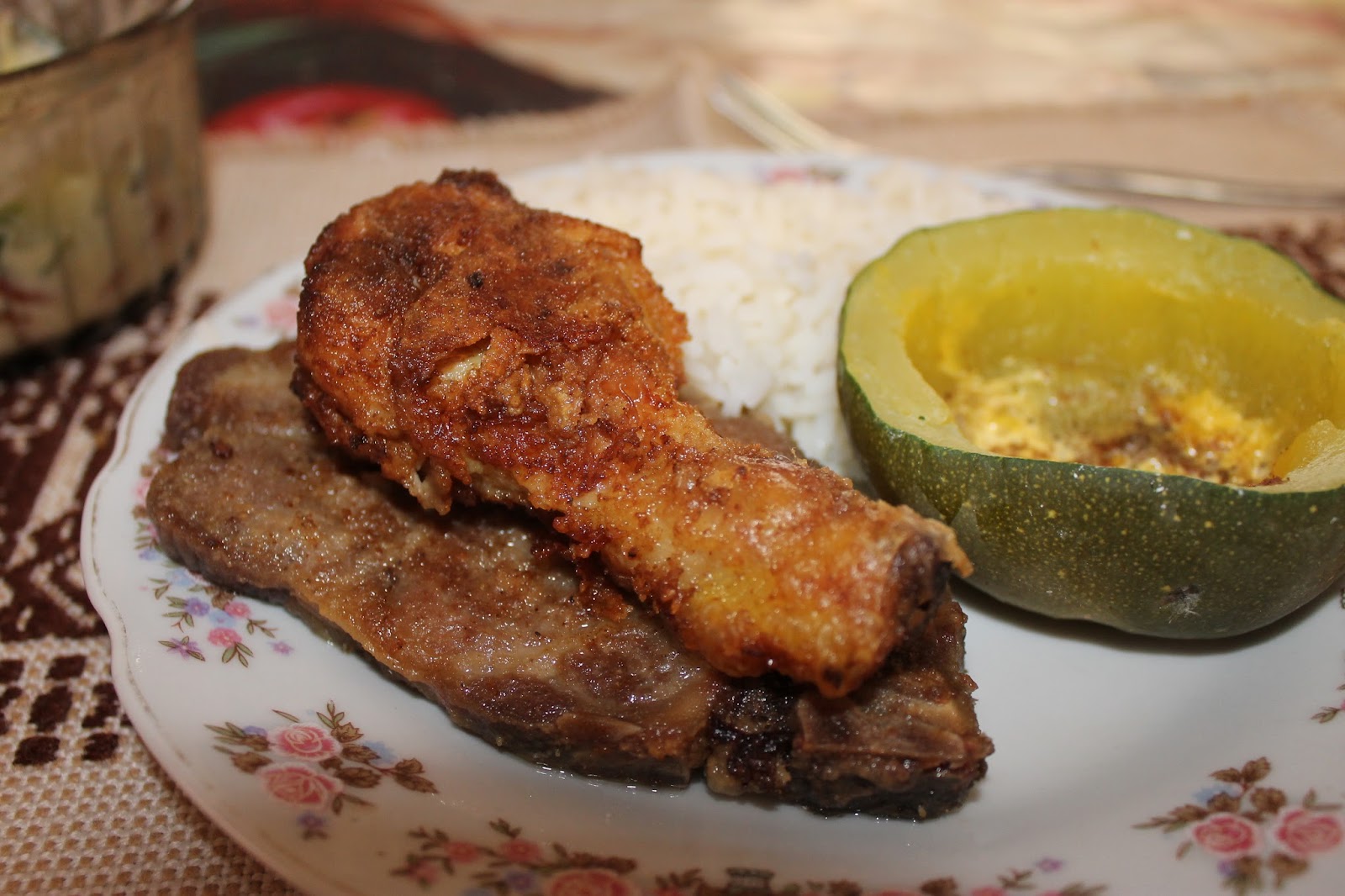
Sundays are especially meat-intensive.  I ate most of the pork
and almost all of the chicken.  The squash was delicious.

So, classes take most of the day.  As a community-economic-development (CED) volunteer, I have had classes in bookkeeping, personal finance, registering a company in Namibia, income-generating activities, creating a business plan and much more.  Many of us, of course, knew a lot of this information already, through work or school or volunteer activities.  Our group of 13 is also partnered up with 13 local people who want to start businesses, and we hosted a business skills workshop for local entrepreneurs and a market day as well.  More on those projects later.

The 13 CED volunteers move into the big room (with the lousy acoustics) with the 18 Community Health volunteers for several sessions weekly on topics concerning safety, medical and cross-cultural issues.  Safety includes warnings about harassment and stalking, prohibitions on riding in the back of open pick-up trucks or in commercial trucks, and ideas about how to intervene if you see another trainee or volunteer at risk.  Medical sessions have included nutrition reminders that included a recommendation to rinse any food you’re not cooking in a bleach solution, a truly grisly slide show with photos of genital warts and other STDs, and a couple of heartbreaking videos, one telling a bit of the story of Danielle Dunlap, a Peace Corps volunteer who died of malaria in Ghana in 2013, and one featuring five volunteers who contracted HIV while serving.

Many of the cross-cultural issues sessions have dealt with the ways Namibian life, mores and people differ from American, both actually and stereotypically.  In one session, our trainers asked questions about American habits they had observed while we Americans asked about Namibian habits we had observed.  Some of the questions from the Americans:  “Why doesn’t my host family rinse the soap suds off the dishes?” and “Why is the toddler in my family allowed to hit her parents and siblings?”  The answers from our trainers were, “Why would we?” followed by a chorus of Americans describing dish-washing in England, Ireland and Canada, where the suds are a permanent part of the place setting; and “Poor discipline.  She shouldn’t be hitting anyone, but some families don’t teach their children proper manners.”  Corporal punishment in the home and schools is not uncommon here; though it’s illegal for teachers to hit learners, they often do so.

A kid I met one day.  They mostly love
to have their photos taken.  I hope someone
is teaching her manners without hitting.

The Namibians wanted to know, among other things, why Americans eat so much peanut butter and what we carry around in our gigantic knapsacks.  The answer to the first, of course, is because Peace Corps’ Namibian staff keeps feeding us peanut butter, though we actually talked about nutritional density and cost-effectiveness.  The answer to the second, of course, was that we carry around about fifteen pounds of paper they’ve given us with information about the national economy, self-assessment, safety and security, sexually-transmitted infections, personal budgeting and how to tell a taxi driver to drive slower, not cheat you and let you out here as you need to use the bathroom.  There’s also a three-pound Afrikaans-Engels woordeboek vor tweetalige aanleerders.  That’s a dictionary for bilingual learners.

We are all feeling quite well prepared for service by this point – week six in the process – and perhaps just a tiny bit sick of each other.  Nonetheless, on weekends there’s usually some group activity, like hiking in the mountains that ring the town, gathering for a movie or visiting a local crafts market.  It’s actually a fairly impressive group, and getting to know some of the members has been a pleasure and an education.  Everything’s an education lately.