Sunday, 10 January 2016

Wild Life


Friday 28 August 2015:  Tonight I saw a giant, dark bug skitter across the room and settle under the dining table.  When I got up from my desk to chase it out, it zoomed across the floor under the desk.  I opened the front door and collected my broom.  Standing well back from the desk, I used the broom to hook my chair and pull it away, and then hook my knapsack by a strap and pull it out, too.  The bug fell to the floor as I did that; I guess it had settled on the knapsack oh ick.  I swept it, with no effective resistance, outside and slammed the door shut.  And locked it, ha!

Have you ever found a gigantic black beetle in your first-world home?  I have, several times.  There were two kind-of noisy ones behind my futon on Park Drive in the Fenway, around 1985, that I was pretty sure I wouldn’t be able to kill with a single shoe, and there’ve been plenty more since.  Big bugs are not exclusive to Namibia.  Occasionally I remind myself of things like that.  The electricity failed more often in McLean, Virginia, one summer than it has in my six-and-a-half months in small-town Namibia. 

Monday 31 August 2015:  Tonight I saw my first spider:  an humongous one; a flat, brown, not-especially-hairy spider high on the wall outside my bathroom.  I did not enjoy seeing it.  I got the spider book Peace Corps provided me and estimated it was probably a wall spider, harmless to humans.  Then I got my tape measure and plastic-tacked it to the wall, kind of near the spider, and took a picture from floor level.  The photo was pretty useless, so I got a chair and stood on that, and moved the tape measure a little closer.  Spider didn’t like that and skittered away, fast and toward the floor; a very kind direction on its part, given I was on a chair.  It rounded the corner into the hall and camouflaged itself against the dark baseboard.

It just would not pose.

I did not want it wandering around while I was trying to get to sleep, so I fetched an Indian take-away container wide enough to trap it, and got as close as I dared, container poised, cardboard ready, front door unlocked and kicked partly open.  As soon as I began my swoop, that thing skated off about 90kph and vanished in the vicinity of the back, across-the-hall bedroom door.  Maybe it went in the room; maybe it was camouflaged elsewhere; I do not know.  I pulled that door closed, sprayed Doom bug repellent all around that door, my bedroom door, all the baseboards, my bed, the bathroom window, and the front door.

The one in this picture looks much spottier than mine.
Key point:  "Harmless to man."


October 2015:  When my PC boss, her assistant, and our new country director stopped in town to deliver a package for me (TWO cases of Kind bars; thank you, C&K!), I showed them around my house, explaining that the back, across-the-hall bedroom door stays closed because a big ol’ wall spider ran in there one night months ago.  They all understood.  Ephraim, assistant boss, opened the door and took a look around, but closed it up again kindly.  (Actually, a streetlight shines in through that window and illuminates the whole hallway, and even into my bedroom, so I'd keep the door closed anyway.)

November 2015:  I invited several PCVs to my place for Thanksgiving, informing them that I have lots of bedrooms, a couple of mattresses, an oven and a microwave - and that I had seen only one spider in four months.  In the week or so after I sent the e-mail, I spotted two or three tiny ones that the spider book did not identify, because they could not have been highly cytotoxic, six-eyed sand spiders that, despite being about the size of my thumbnail and living (very well camouflaged) in desert sands where they occasionally poison and consume an insect unlucky enough to step on them, can kill an entire human being with one tiny bite.  What evolutionary sense does that make?  Anyway, while I refuse to believe these tiny bugs are those most dangerous ones, the spider book says nothing about small, harmless spiders.  So I accord them considerable respect and stay well back.  Mostly I catch them in a take-away container and liberate them in the glorious outdoors, where I believe they will be much happier.


Key points:  "leg span up to 30mm" (roughly one inch);
"Strongly cytotoxic.  Can be fatal."
Not mentioned:  whether it can bite through a hiking boot.


J. arrived around mid-day on the Friday after Thanksgiving, and A. and Y. in the evening.  I had soup to stir when the latter arrived, so I asked J., who’d had the house tour, a desert walk and a showing of 'Dr. No,' to show A&Y to their room, and as I stood in the kitchen their distant murmurs changed abruptly to shrieks of, “Jesus!” “Don’t chase it!” “Mother, that thing is fast!” and such.  Oh, no.  It really is the spider’s room.

There've been a couple more since.  Here is my technique for wall-spider removal:  Spray it with stinky Doom; the repellant kind not the killing kind.  That will mess the poor thing’s central nervous system up enough that it gets a bit slow and staggery, and you can trap it in the take-away container and escort it to a more agreeable location.  Wash your hands really well when you get back inside.

Peace Corps issue!  I do not display them in a beautiful Omba basket (a Christmas
surprise from the M'ville family, arranged I know not how), but usually keep
them hidden under other books.  They are full of grisly photos and info.

Seriously, the spider book is not good bedtime reading.

Tuesday, 5 January 2016

Where I Live Now


So I made it through PST, and out into the desert.  My new home is a small town, built about an hour's drive from the coastal town of Swakopmund in the 1970s to provide housing for mineworkers.  The next closest town is another hour in the other direction; this area was probably never settled in any permanent way given how arid it is, how hot the summer days are and how cold the winter nights.  Probably nomadic people came through here at intervals for tens of thousands of years, but they wouldn’t have settled.

Foreground:  probably more less what it's looked like here for thousands of years.
Background:  former company town.

When a big mine began operations here, workers had to come a long distance to dig the ore, so the mine operator created a town for them.  The original idea was that the mine would be worked out within about 20 years, and the town would be abandoned.  However, by the time of independence in 1990, it was clear that the mine would be productive for at least a decade or two longer than originally projected, and the town housed many people unaffiliated with the mine.  So the mine operator deeded the property, buildings and infrastructure to the nascent nation; the national government created a local government; and the local government eventually determined that they wanted to create a ‘sustainable town’ that could survive and thrive independent of the mine.

It’s a small town; I could probably circumnavigate it in about an hour, maybe ninety minutes, walking.  That would be winter walking; in summer I would melt before I got even a quarter way around.  I haven’t tried the circular route yet because it would be pretty boring.  Sand and scrubby bushes on one side; houses on the other.

A street in town.

The houses look largely alike.  Wood is not an abundant resource anywhere in Namibia, and certainly not in the Namib Desert.  All the buildings – houses, markets, administrative centers and churches (one Lutheran and one Roman Catholic) – that the mine operator built are made of concrete.  They are all single-story buildings, as is the norm in Namibia.  You see high-rises in Windhoek, and two- and three-story buildings in Swakopmund (I haven’t been to any of the other ‘big cities’), but they are very rare in towns and villages.  It gets extremely windy in the desert, especially on winter nights, so maybe the lower profile is sensible from that perspective; I think it’s also less expensive to construct single-story than multi-.  Forty years after their construction, the houses still look very similar to each other – they’re too close together to do much adding or altering – except in color.  We have everything from soothing desert hues to eye-popping citric green, hot fuchsia and deep, pastel orange.  Yards are sand, most with at least some sort of plants, usually hardy succulent-y things, but some with more elaborate gardens.  Many of the streets are paved; a few are well-established sand surfaces.

Longer view of a street.  Bicycles are actually quite rare,
which may be why I took pictures of two of the few I've seen.

A lot of people in the town work at the local uranium mine, or at others in the area.  Mining is, with caveats, a major industry for Namibia.  The principal caveat is that it employs only a very small percentage of the population; less than 5%.  Mining’s importance is measurable more in terms of exports:  despite its relatively small size, this country is one of the world’s leading producers of both diamonds and uranium; Namibia also exports gold, tin, copper and other minerals and ores or whatever the correct term is.  Much of the mining is done in the extra-sparsely populated southern half of the country, where I live.

The uranium is very low-grade and about 10K from town,
so poses little measurable danger to inhabitants.

Other locals work in the several shops we have here – one chain and one independent grocery store, a chain clothes shop, three banks, and a number of small market stalls, where people sell onions, apples, carrots and other produce basics, or hats and t-shirts, or chips and knick-knacks.  There’s an open-air barber shop or two, hair salons and nail salons and two or three lunch places that typically sell stewed meat, some kind of starch and maybe fatcakes.  People also operate these kinds of businesses from their homes.  The town is only about 8,000 people, where I think Okahandja has about 20,000 or a bit more and Swakopmund is around 60,000, but I suspect the number of shebeens (bars) per capita is much lower here than in those towns.  I’ve only seen one car wash, but there may be another tucked down a side street somewhere.  We also have a gas station with convenience store and a post office, and a vocational school that has an excellent reputation, I’m told, throughout southern Africa.

There aren’t a lot of cars, and drivers here tend to be more thoughtful of pedestrians than I experienced in Okahandja or Windhoek.  My neighbors often play loud music outdoors at night, but otherwise the town seems fairly quiet.  It has a big mix of tribes, unlike the more naturally-occurring small towns and villages; people speak Damara and Nama and Oshiwambo and Otjiherero and Kavanga here, and usually revert to Afrikaans as the common language if they’re over 30 or from the south, and to English of very variable fluency if otherwise.  We have a senior library for teens and adults (one large room quite full of a mix of literary fiction, genre fiction and non-fiction, in English and Afrikaans), and a junior library for children.  The town swimming pool recently re-opened, after many years, but I haven’t been there yet.  So far, I’m entirely content to be living here.

Sunday, 3 January 2016

Coming Home

So 18 June 2015 was Swearing-in Day – or Graduation Day – and, for me, Coming Home Day.  Home for the first time, that is; I hadn’t been near my new town before, nor ever lived in a desert.  I’d been told I’d have a big, yellow-walled, concrete house to myself in a small, desert town in mining country, and I could expect a fridge and oven and three-quarter size bed.  The Peace Corps combi had picked me up at Wilhelmina’s house early that morning so I could transport my giant suitcase, big backpack, medium duffle, small suitcase, knapsack and sleeping bag to the training center, and Lou, my supervisor, and I loaded all of that, plus my new, PC-issued water filter and mosquito net, into the Foundation bakkie (pick-up truck), and headed west.  For about three minutes, and then Lou had to stop at a well-regarded biltong (dried meat; like jerky) shop.  He said his daughter had requested it, but I’d guess she didn’t have to ask.  He looks like a biltong guy to me.

Farewell, Okahandja!  Thanks for everything!

We traveled a four-lane, well-paved highway with 120kph speed limit that soon narrowed to two lanes, still fast and well-maintained.  Lorries (big trucks for transcontinental transport) can only go 80kph, so we would occasionally overtake one, which was usually easy given long sightlines and limited traffic.  The scenery outside was the semi-arid savannah of Okahandja for the first hundred kilometers or so, with grasses, lots of big bushes (say 3-5 meters tall), and plenty of trees (up to 10 meters tall, I’d guess; maybe some even a bit taller), in shades of green and yellow.  Mountains heave up intermittently, though the road is mostly flat.

Semi-arid savannah, about three months after rainy season ended.  It was
a lot greener two months earlier, and would get a lot yellower and browner
before the rains came again six or so months later.

As we traveled, seeing very few signs of human habitation for scores of kilometers at a time – you could be in South Dakota, maybe – the landscape gradually grew scrubbier.  Over the next hundred kilometers or so, the trees got shorter, and eventually pretty much stopped; the bushes got smaller, and the grass sparser and yellower.  The sandy soil was more exposed and looked rockier.  There were a few small towns right on the highway, with filling stations that offered gas, clean restrooms with toilet paper for $2, bottled water, snacks and energy drinks.  Or you could just refill your water bottle in the restroom, since tap water is safe to drink all over Namibia.  Yay Namibia!  This is, of course, not even vaguely true in much of the developing world and parts of Washington, DC.  (There was a big arsenic problem a few years ago that cut water supplies to several neighborhoods there.)

Desert at dusk, with town in the distance

Outside the town of Usakos, we stopped at the Ûiba Ôas Crystals Market, one of the small businesses my foundation works to support.  The market is a project of a small-scale miners’ cooperative; the miners are mostly men, and their wives, mothers, daughters – and some men – sell the stones they mine locally at the market.  Ten years ago they had some rickety tables by the side of the highway; with the help of the Foundation and various grant-makers (the EU, the US Embassy, the Namibian Social Security and others), they’ve expanded to a solidly constructed, three-room showcase with mostly open roof.  Lou introduced me to the sellers, and many of them invited me to buy stones, which I had to decline with regret.  I am bewitched by the aquamarines – maybe that’s related to my fascination with water – and I like the deep purple of an amethyst.  Amethyst, incidentally, is from the ancient Greek for ‘not intoxicated’ and the stones, per those Greeks, was believed to prevent drunkenness.  They don’t really.  The miners also find garnets in the local rocks and mountains, which are supposed to support solitude.  I am not bewitched by garnets; solitude seems to come easily to me.

They also mine many colors of quartz, topaz and other stones.  I’ll write more about Ûiba Ôas in a later post.  There’s a lot to say.

Crystal seller


Eventually we made it to my new town.  We stopped by the office; the building also houses the town library and I met one of the librarians, a lovely woman.  I was so excited to have a library right next to my office!  There was also a custodian/janitor/handyman, whose handiness would become highly meaningful to me over the next few weeks.  We then traveled on to my house, where I met a local plumber who was putting the finishing touches on my toilet, and my Foundation coworker Anna.  Anna had been putting the finishing touches on my furnishings, and brand new sheets on my bed.  “It’s inhuman to ask you to come here and not even give you sheets,” she told me the next day.

She had also provided silk flowers in a shining vase, sweets and chips on a golden platter, a welcome card, and a bottle of sparkling apple juice to toast my new home.  Lou and Anna and I sat together at my new table and wished each other joy and success in our coming collaboration, and they promised to see me bright and early the next morning.  After they left, I kicked a few suitcases out of my way and went, somewhat gingerly, to bed in my soft lilac sheets – with my sleeping bag on top for much needed warmth!


Wednesday, 30 December 2015

Graduation Day!


On the 18th of June in 2015, the 31 Peace Corps Trainees of Namibia Group 41 officially became Peace Corps Volunteers.  Yee haw.  The training staff were all very pleased with us that NO ONE went home during Pre-Service Training.  Apparently, they usually lose up to 10%, and sometimes more, during the process. 

Graduation day is the same day as moving-to-your-new-home-for-the-next-two-years day, so it was quite busy.  (Well, actually, I and many colleagues moved to our new homes on graduation day, but some people moved to temporary quarters until their new homes were ready, or stayed one more night in Okahandja because they were moving someplace very far away and needed a full day’s worth of daylight to make the drive.  So.  There’s always a wide range of experience in Peace Corps service, even in the same country, specialization and time period.)  I jotted a few notes a day or two later, and took several photos of the ceremony part, and saved my program, so I may be able to reconstruct a bit, from the distant vantage of December.

Trainers prepare the stage.

Two days before graduation – which Peace Corps calls Swearing In – we met the site supervisors with whom we’d be working for the next two years.  (Most of us, of course.  Again, some supervisors did not attend; a few sent counterparts instead; and many PCVs will interact with supervisors only rarely, spending most of their time solo or with counterparts.)  My supervisor is a very cheerful native Namibian man of about 40 who has worked in capacity development for a decade or two.  He is very excited about the opportunities we have to assist local entrepreneurs, both individuals and collectives.  He likes to joke and laugh, so I’m very comfortable with him.

Our whole group – 31 trainees and almost as many supervisors – did a series of exercises on Monday and Tuesday to help set expectations and support our efforts to work together effectively.  For me, nothing surprising emerged from those training sessions, and I think my supervisor felt the same.  I think the most useful and the most fun part was getting to know each other, and other supervisors from other parts of the country, over lunches and tea breaks.

On Swearing In Day itself, we had to be at the conference center – a new one; not our trusty training center – well before the ceremony started, probably to ensure everything was in place when the dignitaries arrived.  Many of the incipient PCVs wore Namibian clothes, either traditional attire or contemporary outfits they had ordered from a fashion designer and seamstress who was one of our Community Economic Development business partners.  We chattered together and took each others’ pictures for an hour or two, and then took our seats for the ceremony.

Traditional Damara dress; contemporary Namibian dress; US dress;
US slacks and shirt; contemporary Namibian dress with US sweater;
traditional Herero dress.  Deliberately silly poses.  Note the 'tradition'
of cloth dresses in Namibia isn't much more than 100 or 150 years old.

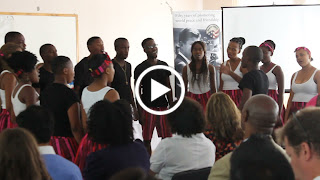
We opened, of course, with the African Union, Namibian and US anthems, which all of us PCTs knew well after singing them at least weekly for nine weeks.  Then the Okahandja Youth Choir took the floor and demonstrated how real singers sing.  Benna, our training manager, presented us, and Danielle, our country director, accepted us, and the Peace Corps Regional Director for Africa, Dick Day, celebrated us and all those who supported us through training.  Then Danielle led us in our pledge of service, which we had already had to read and sign, along with an oath of loyalty to the US – a modified version of the ones sworn by federal employees and military personnel.  At that point, we were officially Peace Corps Volunteers, and it was all so exciting we needed the OYC back up for another song or two.


More speeches – lovely and touching and rife with the metaphors of school graduation ceremonies; all apt.  In accordance with Namibian mores, each speaker began by thanking all the other speakers, special guests, and three or four people ‘in absentia’ – those were the dignitaries who had planned to attend but had to cancel at the last minute, who included the US ambassador and the local police chief.  After two to three minutes of thanking, the speaker says, “The protocol is observed,” and moves into the unique part of his or her remarks.  It makes for a longer, slower ceremony than one might find elsewhere.

Benna, Danielle, Dick, Local Official subbing for
Honorable Councilor Steve Biko Boois in absentia


Two volunteers made thank you speeches in their new languages – one Afrikaans, one Silosi – and three recited a poem they had written, together, in their three new languages: Afrikaans, Khoikhoigoab and Rukwangali.  People cheered like crazy.  The Okahandja Youth Choir performed an impromptu song when the P.A. system went wobbly and we sat waiting for it to be fixed.  We did all the anthems again and then went outside on another gorgeous day for a lavish buffet that was not quite lavish enough to feed everyone.  Many of us new volunteers looked a bit bemused, as the realization that training is done and we’re off on the independent, on-our-own part of the adventure.   Two of us will be living in huts made from reeds.

Three days after being sworn in, I took this photo
of the desert sky from my new back yard.  21 June 2015.

Six months later, as I type this, we have a new country director (the impressive and delightful Danielle resigned the day after our swearing-in), and four of my Group 41 friends are back in the States to stay.  Winter has turned to summer, and the difference isn't great:  nights are warm and days are too hot, instead of cool-to-cold nights and perfectly comfortable days.

Tuesday, 29 December 2015

PCN 41 - My Group


My group of trainees is Namibia 41 – the 41st team to benefit from service in this beautiful country.  The first team traveled here in 1990, the same year Namibia elected its first president, and became officially independent.

In Philadelphia in April, deployment day.  Three of this
group came to my house for Thanksgiving.

We are 13 volunteers in the Community Economic Development program and 18 in the Community Health program.  We are all college graduates (typically a Peace Corps requirement, which I believe stems more from host country preference than PC prejudice.).  Several of us have lived in Washington, DC; three are from South Carolina.  New Jersey and California are heavily represented.  Enough of us have moved around that we qualify for two or three answers to the question, “Where are you from?”  The Californians like to argue the LA vs. San Francisco question.

The youngest is 21 – there might be two or three of these – the oldest is mid-sixties.  Average age is mid-thirties, although I think there is only one person in his 30s and two in their (late) 40s.  We have five or six in their 50s, and two in their 60s, so 20 or 21 are in their 20s.  Everyone seems smart and committed, and professional experiences vary widely.  There’s a former president of an east African college, a former entry-level investment banker, a coffee-shop manager and a wide range of others.  Religious backgrounds are equally mixed; most of us are not regular churchgoers; a few are devout.

At Heroes' Acres outside Windhoek in May.

Financial backgrounds range pretty wide, also.  There are plenty of us who are accustomed to scrimping, and others who clearly have more substantial financial resources.  The group includes twenty-five whites, four blacks and two Asians.  The blacks and Asians get frequent warnings that locals may not believe they are Americans, since the American media Namibians see is heavily focused on white culture.  The whites get warned that we may get preferential treatment given our skin color, which may make us uncomfortable, or very occasionally encounter anti-white prejudice.  I know I don’t have to check my shopping bags with security when I go into the supermarket, and my black Namibian business partner does.  Ick, right?

It is not uncommon for a trainee or two to decide that Peace Corps isn’t for him or her during the Pre-Service Training, which the staff also admits can be a Pretty Stressful Time.  So far (written in June 2015; posted in December - whoops), we’re all holding steady, even the people learning the quite challenging Khoi Khoi language, with its four precise clicking and popping noises.  Two people have been sick enough to require treatment in the capital, Windhoek, and one person has dropped a water bottle on another resulting in two broken toes.  Everyone seems to have found at least one or two colleagues to look to for support and friendship.  I am still charmed and delighted by my two roommates from the first week, and finding all kinds of other gems in the mix.

Roomies!  In Swakopmund in October.

I wrote the preceding paragraphs in June.  Now it is December, and four of us are back in the US for good – three from the 40-plus demo, which I believe is unusual.  I’ve gotten to know a few of my class better, and two or three from previous classes, and had four PCV friends visit for Thanksgiving weekend, which was wonderful.  (More on Thanksgiving later; probably, like, next May?)  This is probably the most admirable, most likeable large group of not-quite-randomly-selected people of which I have ever been a member.