Sunday, 31 July 2016

Merry Boxing Day


K writes:  “Reading [the blog] out of time – you write about November in April, etc. – just gives an exaggerated feeling of how far away you are.”  I rather like that idea.  Yeah.  That’s why I do it.  Anyway, this is from December 2015:

Much of Namibia shuts down for the ‘festive season,’ which is essentially December.  That’s prime planting season, as the rains start about then – in November in lucky years, January or February in less good times.  Lately it’s been as late as March.  ‘Rains’ doesn’t mean a 20-minute sprinkling, which can happen anytime (but only very rarely does), but a long, thorough, drenching rain that goes on for hours, and recurs every day for weeks or months.  When they do start, you want to be ready, so people living in towns and cities head for farms and villages, especially in the riverine northern parts of the country, where the best growing and most people are.


The Namib desert is not renowned for its agriculture.

So my foundation closed for five weeks: 4 December until 11 January.  Almost everything else was closed at least 11 December until 4 January.  Many of my friends headed to farms; Peace Corps volunteers around the country headed for Victoria Falls, Etosha, Swakopmund, Capetown.  I stayed snug at home.  After the first week, a circuit blew at the office, so I couldn’t even go in and work on my business training slides.  And oh, my goodness, did it get HOT.  The Afrikaans language has no word for ‘hot,’ which is deeply weird.  You can only say ‘warm’ (pronounced ‘vahrm’) and ‘baie warm’ – ‘very warm.’  What they need is a word for hot, and another word for a desert summer day 20 degrees from the equator, at sea level; something that would approximate ‘blisteringly, meltingly, expletive-deletingly, unnecessarily, gruesomely, hellishly hot.’  Seriously.

I turned my desk into the sideboard.

However.  Christmas.  My friend Fabiola had not completely abandoned our small town, so I invited her, George and Cherial over for Christmas dinner.  But then they wound up spending Christmas with family after all, so they would come instead on Boxing Day, the 26th.  Except that Cherial wound up staying at her grandmother’s farm after all, so my Christmas 2015 was one day of sweating quietly on the couch, and one day of cooking and festive-izing with Fabiola and George.  We had crackers – both the pop-gun kind with crowns, and the ones that go under cheese.  Fabiola and George willingly tried cheese and crackers, but remain skeptical of the concept.  We listened to Christmas music, thanks to Noisetrade, and looked at photos of the USA.  “Is there always water in the river?” George asked of a picture of the Mighty Mo.  “Yes,” I said.  “That much?!” he demanded.  “Sometimes more,” I clarified.  He’d like to see for himself.

Preparing to roast carrots, onions and green squash

Yorkshire pud to be.

Mushroom sauce.

Filet of BEEF!  Leaving me free to get at most of the pud, with sauce.

Mince pie.  The fancy grocer provided the prepared filling; very sticky and very, very rich.

It's rather a heavy meal for such a hot day, really.

On the 27th I got an SMS from the post office saying there was a Nampost Courier delivery for me, and I figured it would be something from Peace Corps HQ in Windhoek.  Like, magazines or something.  But when I went and collected, it was a PRESENT!  For CHRISTMAS!  Sister3 elaborately arranged for a gift-basket delivery via Omba in Windhoek.  (I am blessed with kind and generous friends and relatives, but everyone who had thoughtfully put parcels in the US post back in November got their thank-you e-mails when I received the lovely Christmas deliveries ’round about Valentine’s or St. Patrick’s Day.  Gosh, mail is fun.)

Prezzies!

Merry Christmas to All!


Thursday, 21 July 2016

How Green Was My Desert

As my new boss drove us out of the central Namibian savannah and into my new desert home last June, he talked a bit about the landscape.  While much of Namibia enjoys a rainy season in the summer (late November or early December through March-ish; Andy writes eloquently about it), the Namib Desert doesn't go in for that sort of thing much.  However, Lysias assured me if it did rain, the desert would turn brilliant green!  I've heard and read about the wildflowers that bloom in the southwestern American desert after rainfall, and have yearned to see that.  So I crossed my fingers.

And it rained several times in the first few weeks I was here.  And the desert did nothing.  Over time, I have come to understand that 'rain' doesn't mean the twenty-minute sprinkles of last winter.  'Rain' means something like what happened in mid-April, when we got hours of steady, serious rain one Wednesday afternoon.  So I went hopefully into the desert with my camera, and found sand.  Lots of sand, the usual scrubby bushes, maybe a couple of small white or yellow flowers.  Every other scrap of flora was some shade of brown, including the brownish-green of the most ambitious bushes.

Well!  On the sixth and seventh of June -- we got rain.  We got slamming, torrential, amazing bucketloads of rain pouring down on us from late on Monday, when there was hail, too, until Tuesday afternoon, with frequent intermissions and resumptions.  It was astonishing.  People were saying, "not for ten years," "not in twenty years," "never in my lifetime."  Along the coast they had slashing great streaks of lightning, and closed roads as the water pooled up, waiting for the sand to find room for it.

The junior library roof leaked quite a bit; many homes did, too.  Why not?
The sand's going to get in with the east wind no matter what, and rain is not
an issue - until today.

A fairly brief clearing in the morning.  This kid had probably never waded
through a puddle not made by a carwash before in his life.  And maybe never again.


The powerful east wind of winter is usually a late-night and morning
phenomenon, but it kept up through early afternoon on The Rainy Day.

And the water hung around for hours -- in some places, days -- too.

So, that's rain, right?  That's really rain.  The water stayed pooled in a few places, in the desert, for a week or more.  So a few days after the storm I went out with the camera, and found... sand.  Scrub.  A couple of flowers and a few new patches of green stuff that reminds me of star of Bethlehem.  Nothing, though, proportionate to the excitement of that rainstorm.

Okay, greener than usual, but...  (The evening light is lousy
for capturing the green tones, but there are a few in there; there really are.)

A month after the rain, camera-less, I started to notice... tiny, thick-leaved green things.  Brighter color and more leaves on the bushes along the river tracks.  And in a few places, grass!  Like what they have in the savannah for game and cattle!  Grass!  A few days later, I took out the camera for real.  Recently I've been telling people I'm going to get myself one very small cow, and start a farm.

Grass, sparkling and waving, like this is a prairie or something.
It makes my heart sing; it really does.

The green follows the curve of a shallow indentation, presumably once
a 'river', which is what they call the dry channels here that funnel water
through the savannahs every two or three or four years.  Or twenty.

Green!

Green and a bit succulent.

Seriously, one, very small, cow.  A Jersey, perhaps.  Ooh, wait.
She won't like the water here; it's very chalky.  Never mind.

 
 All the photos, including several of flowers in white, yellow and purply-pink, are here.


Friday, 15 July 2016

A Few Notes from Gideon

Gideon was one of the first people I met in my new home.  He works in my building as a cleaner, gardener, general handyman and IT specialist.  Not kidding.  He's one of the best at keeping the library's computer lab running.  He also sings in the big choir at the big Lutheran church and smiles a lot.  He picks up the mail for my foundation, and one day he brought me a postcard one sister sent from Paris.  I spoke a bit of French for him, and the next day he came into the office and asked, in French, if he could sit for a minute.  He learned the words on a phone app.

Today he stopped by and agreed to a brief interview.


He was laughing through his struggle with English,
and I grabbed the camera to take a picture.  As soon
as the lens cap came off, he made this serious face.

Name:  Gideon Gomachab  What do you do for work?  General worker; I am doing everything.  What do you like most about your job?  I enjoy reading and watering the garden.  And what do you do for fun?  Singing and doing maradon.  Maradon?  Marathon running.  Mostly I participate in the Rössing marathon and Areva marathon.  I usually do five kilometers.  Not the long run; the 42 kilometers?  I would not be able to do that thing – it's too far.  How long does the five kilometers take you?  About 45 minutes.  When was your last singing competition?  It was in June, with the church, in Uis.

Gideon at work, keeping the grounds beautiful.

Where did you grow up?  Sesfontein  Do you like it better here in the desert?  I don't like the desert, but I stay here.  I came in 2006.  I came to study and then started working.  I stayed for the job.   How did you learn so much about computers?  I was helping the people in the library who needed to do this, this on computers, and then I went when the man taught some classes from Rössing Foundation.  But mostly you taught yourself?  Yes, yes.  Mostly I just learn myself.

What's your first language?  Damara-Nama  And what other languages do you speak?  English (pronounced 'Ingleez')  I'm not good in Afrikaans but I'm learning.  Also a bit of Otjiherero.  Fabiola says you're really good at Damara-Nama.  You write it really well.  I used to write elder people's wishes every Sunday for the radio.


Trying to think what's 'typically' and 'un-typically'
Namibian about himself made him laugh so much he
didn't notice the camera until too late!

What's 'typically Namibian' about you?  (Gideon thought a long time to come up with an answer for this one.)  I keep a garden and grow typical Namibian food like mielies, wheat grain, pumpkin and watermelon, and sometimes we are also growing tobacco and then we are selling to the big companies.  What's 'un-Namibian' about you?  (Again a lot of thought, but this time he could not come up with anything.)


Wednesday, 13 July 2016

Happy Anniversary

looking back to December 2015:

Following on a delightful Thanksgiving, us five PCVs gathered at my house for festivity and fun had to get ourselves to Windhoek, Namibia's capital, for Peace Corps Namibia's biennial (every other year) All-Volunteer Conference, which in 2015 also incorporated PCN's 25th Anniversary Celebration.  Whoo hoo.

December (and part of January) is 'the festive season' in Namibia, and a lot of businesses shut down for several weeks.  (My foundation closed for five.)  This reflects a combination of year end, Christmas and the onset of summer, which is also the rainy season.  Many, many (maybe most) people who might otherwise live in towns are needed back in their family villages for planting and other field work.  So enormous numbers of people are traveling, especially in early December, and even the last day in November.

This was vividly clear when we got to the hike point and found dozens and dozens of others waiting hopefully for rides.  Sadly, travelers on the road were much scarcer, and we stood for about two hours in the blazing sun (occasionally ducking under the crowded canopy available for waiting travelers, but it's too far from the road for anyone actively working to bag a ride) before three of us got a ride, and maybe another ten minutes before M. and I scored a sweet double-cab bakkie with a local tour guide.  On the three-hour drive, out of the desert and east into the savannah, we saw, heard, smelled rain lovely rain at several points.  Whoo hoo.

Swanky!
The rooms weren't nearly so luxe, but who cares?!  Let's go to the pool!!

We got to stay at the plush Hotel Safari for this special event, enjoying swimming pools, workout rooms, and extremely generous buffets (and many thrilled/thrilling conversations about special treats like cheese! and fresh berries! and dessert!).  We had two days of conference activities, including reminders about Peace Corps rules and several 'Open Spaces' discussions.  Open Spaces is a meeting methodology whereby participants engage in multiple small-group conversations at once.  Patrick, our admirable director of programs and training, invited suggestions for topics, and then volunteers to lead or manage the conversation for each topic.  If you're not leading a group, you can wander from place to place and touch on several different subjects, or settle in to a single one that grips you specially.  There were about 130 PCVs at the conference, who came up with subjects like "Macroeconomics of Namibia", "Dealing with Difficult Supervisors/Counterparts", "Classroom Discipline", things like that.  It's a useful format to keep people engaged and share practical ideas.

And this is just part of the cold buffet!  Cheese tray at the back.  Hot foods
just steps away.  Everyone ate about three times more than they do at home.

We also spent a few sessions in our sector-specific groups.  PCN supports programs in three areas that the Namibian government has requested:  education is the largest, then community health, then community economic development.  CED is the youngest program and it's growing fast.  The Health volunteers mainly focus on HIV and AIDS prevention and treatment, but also do a lot of work with tuberculosis, malaria and nutrition, with plenty of other areas, like exercise, coming in for attention, too.

Community Economic Development is not, typically, conducted
under chandeliers here.  But just this once.

We also got free t-shirts.

The third day was the anniversary celebration.  The government of Namibia actually reached out to the US Peace Corps before it was even officially the government, in the aftermath of South Africa's concession of the territory but before the transition to the new, freely-elected leaders in 1990.  They asked for teachers; the independent nation had chosen English for its official language, and most people did not speak it.  So Peace Corps started setting up its administrative infrastructure (pretty lean), and soon after Sam Nujoma was sworn in as the first president, 14 US volunteers arrived and dispersed to various towns and villages to try to teach English.  Since then, over 1,500 volunteers have served here.

A few volunteers organized a photo contest in memory of J.P., an ec dev
volunteer who died in a swimming accident at the end of 2014.  I never got
to meet him, but he was much admired, loved and mourned.

We were honored by the participation of Namibia's Prime Minister, Saara Kuugongelwa-Amadhila, who gave the keynote address.  We also heard from the Hon. Thomas Daughton, US ambassador to Namibia, Dick Day, the regional director for Peace Corps's Africa operations, Carl Swartz, our country director, and my friend Kaan, an economic development volunteer, who put his speech on his blog.  We also got some lovely singing from the Okahandja Youth Choir, who entertained us when we first arrived in country, and again at our swearing-in.

The OYC performed more in the hall after the official ceremony;
they've recorded a CD and were selling it.

Then they let us loose on the cake.

The anniversary made national TV; I don't know whether the cake did.
But it had four flavors under those flags.

It's actually a bit inspiring to me to think my small efforts are part of this larger continuum.  And it is definitely inspiring to meet the other volunteers and hear what they're doing, and how they're overcoming frustrations (continual and very real), and celebrating successes (large and small and also continual, especially the small).  The Peace Corps staff are also amazing; Patrick, Linda and Efraim (the ones I see most) work with extraordinary diligence, competence and commitment for us volunteers, for Namibia and for the greater idea of service to community.  Sappy?  Maybe, but real, too.  And I got to go swimming, kind of a lot.

The view from the pool, floating on my back.  There was one day
when I swam in a very light rain.  Bliss.

Sunday, 26 June 2016

One Year Since

In mid-April, at the anniversary of my arrival in Namibia for Peace Corps service, I had in my head the idea of a blog post about things I haven’t done for one year or more.  I started a mental list, thinking I would post it on 18 June, the anniversary of my swearing in as an official Peace Corps volunteer and my arrival at my service site.
 
Then I got a cold.
 
Not having been sick for a year or more was one of the landmark items on my mental list.  I usually get at least one cold every year or two, and many of my PCV colleagues have had multiple bouts of illness (often digestive).  Through my 20s and 30s it wasn’t uncommon for me to get several colds a year, with terrible coughs, and an occasional attack of something the doctor would call bronchitis, and that kind of stuff.  But I had been really healthy more or less since 2013.
 
Then I got a cold.
 
I was up in Otjiwarongo for a permagardening workshop (excellent – expect a post about it by August, maybe, heh heh heh).  I had been in Okahandja twice in the previous month.  The nights are starting to get chilly.  I think, between the travel, the change in the weather, and the very starchy meals I’d been eating in Otjiwarongo, my immune system just decided to take a little break for a few days.  The cold was pretty mild, and did not generate the horrible hacking cough that makes my life, and that of everyone in hearing distance, truly miserable.  Half a box of tissues later, I was fine.


Tangentially part of the permagardening story.

Then my PC boss Linda asked me to go back to Okahandja.  And I had guests, so I would not have time for laundry (a full-day affair, really).  But there’s an automatic clothes washer at the guest house where I would stay in Okahandja.  Dropping my dirty clothes into a machine, twirling a dial and walking away, and returning to magically clean clothes, was another item on my haven’t-done-in-a-year list.  The temptation, however, was too great.  I did not try to get by on the remnants of clean wardrobe I had; I packed some laundry soap and dirty t-shirts and headed to Swakopmund, first stop on the way to Okahandja.
 
And I ate nachos.


There's a creamy cheese instead of sour cream - thicker, a bit tangier.
They call it 'cottage cheese' on the menu but it's not US-style cottage cheese,
thank goodness.

There’s a couple of places in Swakop that offer nachos; I had them at Tiger Reef, right on the beach.  Fifty bucks, or a bit less than five US dollars, and the guacamole wasn’t the avocado-iest thing I’ve ever eaten, but it didn’t taste like frozen lettuce like the guacamole I used to get in Dublin in the 90s.
 
Then I went on to Okahandja and did laundry in the machine.


Forced to choose, I would prefer to live without nachos the rest of my life
rather than go without this bliss-inducing wonder machine.

So that’s three things off my list:  I have been sick, I have eaten nachos, and I have done laundry in a machine, and all quite recently. 

Things I still haven’t done, though, for at least a year:  drunk really good wine, or carefully constructed a menu for a meal to pair wine and food beautifully; driven a car on the highway (I sometimes have to back up the company truck stored in my backyard in order to get at the laundry line, and then drive it forward again into its hiding place); flown in a jet, regional or otherwise, or even been to an airport, or taken a train, subway or public bus; lifted weights; gone on vacation (coming in September); worn tights or nylons; spoken to a member of my family or anyone I knew prior to 13 April 2015; eaten real whipped cream; played with or walked a dog; or been in a city with a population above 500,000.
 
Things I have done in the last year that I had not done before include:  knowingly eaten worms, skydived (tandem and static line, which required riding in a very small plane), ridden in a car going 180kph, said intelligible words that contained clicks and pops, put a condom on a wooden model of a penis with an audience watching, explained what 'noon' means, agreed to allow a small group of total strangers touch my hair, met a US ambassador, and eaten chakalaka.  I love chakalaka.  Kind of.


Oog.  I just ate the nice dried worms, not these slimy-looking cooked ones.


Wednesday, 22 June 2016

Recommended Reading

"Non-readers become readers, readers become writers and writers become... weirder," one of the Volunteer Service Network members told us in pre-service training.  I do not consider myself a writer, as I don't write for pay, and may I confess I don't feel any weirder -- or even weird, actually.  However, I've had the time and lack of internet access to do a good bit of reading in the last year.


One of the first books I found in the town library was Pumla Gobodo-Madikizela's A Human Being Died that Night, and I was awestruck.  Gobodo-Madikizela worked for South Africa's Truth and Reconciliation Commission, and as part of her efforts she agreed to interview Eugene de Kock, whom the South African media had nicknamed 'Prime Evil' for his role as leader of a police task force that targeted anti-apartheid activists with kidnapping, torture, murder and more.  Her book is about what she learned from him, and about herself, and about trauma and forgiveness.  For me it was mystifyingly uplifting.  I was reluctant to read it, but the jacket blurb drew me in and Gobodo-Madikizela's writing captured me.  She relates an extraordinary experience, and her varying response to it, as she feels fear, horror, sympathy, contempt and empathy for a very ordinary man who committed extraordinary atrocities in service of his people, his god and his state.  He thought.  He maybe was changing his mind as he worked with the TRC and testified, and got convicted with two life sentences plus 212 years in prison.  Many higher authorities in the apartheid regime were never charged or sentenced at all.  (De Kock was granted parole last year.)  This book is astounding.


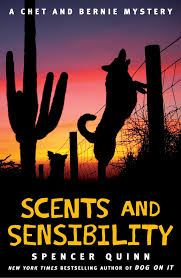
In a very different vein, in July I received Spencer Quinn's latest in the mail -- Scents and Sensibility.  (How wonderful to have an obsessive sister and compulsive brother-in-law who truly understand me.)  This is the eighth in Quinn's Chet and Bernie series of mystery novels told by a dog detective, Chet, who works with a human detective, Bernie.  Quinn's rendition of Chet's voice is exactly what I think most of the dogs (especially the big ones) I have known would sound like if they were tracking perps (and javelinas, with their 'pesky tusks', and pizza crusts and kidnapped elephants) through the Arizona deserts.  He cheerfully acknowledges he doesn't do well with numbers above two, praises Bernie's beautiful big, dented nose and occasionally is quite surprised to find that somehow the upholstery's gotten chewed, or Bernie's accelerator foot's been nudged.  Funny and wonderful and the good guys usually, mostly, win in the end.


I brought Dorothy Gilman's Uncertain Voyage with me.  This is a precursor to her popular Mrs. Pollifax spy series, and concerns a young American woman using a European tour to celebrate and cement her recovery from depression in the mid-1960s, when people admitting depression were rare and uncertain.  Melissa gets, quite accidentally, involved with what may be international espionage, with a possibly-heartless but often sympathetic playboy, and with her own demons as she travels through Copenhagen, Paris and Majorca.  Her voyage is one of discovering her own value to herself, and her will to live.  I found it in the library in 2013, a year of disconcerting change for me, and had to seek out a copy for myself.  It really resonates in valuable ways as I set about changing my life up a bit.


Another local-library discovery was Barbara Kingsolver's The Poisonwood BibleI'll let Alex tell you a bit about that one, as she's also discovering it now, as she serves in Peace Corps Namibia.  Kingsolver is a brilliant wordsmith, and with this story she's constructed something ornate, fascinating and honest.  I've just started Dave Eggers's What is the What, and am happy to recommend it on the basis of the first few pages.  He calls it a novel, but it's based on the reminscences of, and a trip to east Africa with, Sudanese 'lost boy' turned American college student and low-wage worker Valentino Achak Deng.  Eggers is always interesting; Deng is tough and true and observant; and the metaphysical question of when a biography becomes a novel adds a head-floating element to the experience.


L. gave me a copy of Chimamanda Ngozi Adichie's The Thing Around Your Neck shortly before I left the U.S., and I read these lyrical short stories about Nigerians at home and abroad in my Jersey cottage, on the plane and in Okahandja at PST.  Then I passed it along to F., who has since passed it to others.  When I found her Half of a Yellow Sun on the library shelf, I took a deep breath and ploughed into it.  The Biafran conflict, and the world's response to it, was horrifying, and this story of a half-dozen or so mostly middle-class Nigerians negotiating it and its physical, emotional, political and psychological tolls offers a chance to understand conflict and its consequences in a profoundly human and humane way.  Does that sound pretentious?  Maybe just:  It's terrible but beautiful, true and worthwhile.

The library, and the PCV exchange, has also yielded old favorites Wodehouse, Sayers and Scottoline (no Heyer?!), lots of Mills and Boon, Chuck Palahniuk's interesting Invisible Monsters, an odd Harlan Coben (all Coben is odd), and a bunch of John Le Carré, whom I find immensely depressing though I like the Karla trilogy and was drawn deeply into The Little Drummer Girl, with all its horribly dismal, realpolitick moral quandries and equivocacies.  Worth a read, though!  Whatever else you do in life, may I strongly recommend you steer well clear of a 2011 Harlequin Romance called The Reluctant Princess.  Oh, my stars.  To think someone got paid for that.

Friday, 17 June 2016

Oh, So Thankful

Looking back to November 2015:

Sometime after Halloweekend, a few of us who had gathered for that started e-mailing about Thanksgiving plans. Several of the PCVs had trips arranged already, but eventually five of us decided to gather at my house, which was the largest one available to us, and has a microwave. It’s also close to Swakopmund, and pretty much all PCVs like to go to Swakop when they can.

Saturday we got into some serious cookery -- well, a few of us did.
Others made mulled wine and played with the camera.

I love all of these people a lot, and set to work sweeping out five months worth of sand from the unused rooms happily. Gosh, the top of a closet can get awfully filthy when the east wind gets obstreperous. I put sheets on beds and bought winter pillowcases (flannel) for the manky pillows. The cases were on super-sale at Mr. Price Home, since summer was coming. And I made soup.

J. arrived early on Friday afternoon, the day after Thanksgiving. A. and Y. were stuck at the filling station in Khorixas; the elections had dramatically reduced travel, and they were having trouble finding a hike. While we waited, J. and I watched Dr. No, which he had never seen (“You guys,” he would later tell A. and Y. in amazement, “she has discs!”), and then strolled out into the Namib to look at the rocks. We also examined a small, mysterious structure I had thought might be a nesting box; I never examined it because what if it was, and what was nesting in it was not nice? So I actually gave it so wide a berth I didn’t even know it was a four-panel sign post. We decided it had been put there by aliens, and got the proof minutes later when we saw a whole lot of rocks carefully arranged in the shape of an airplane. Clearly, alien transport.

No explanation for this one.

I got in the cockpit and began to fly the plane. “Wait,” J. said, “that’s not a tail wing. What is it? You can’t fly a plane without a tail wing.” So we stepped to the back of the plane and examined what we had thought was the tail wing, and discovered that those rocks spelled out the word ‘Jesus.’ “Jesus is my tail wing,” I was able to tell J., and got back to my flying.

A. and Y. eventually arrived, tired but happy, and met the spider, and we had soup and watched ‘The Butterfly Effect,’ which was disconcerting. But everyone was eager to get to bed so we could get up early and go off to Swakop! Which we did, landing a sweet ride in the back of a bakkie, the four of us plus one stranger. I was sitting on the foam mattress that is a fairly common feature of bakkie backs, but Y. was half on and half off. I encouraged her to scooch up a bit, but she said no, she was fine, and now she claims it was a traumatizingly uncomfortable ride. Humph. The poor fifth guy was so cramped up that when he got out at the Fruit and Veg he almost crumpled to the ground.

They only put pretty pictures of themselves
on their blogs.

And oh, that Fruit and Veg! The others hadn’t seen so much produce in one place since arriving at their sites, and the exotic treats like tahini (can’t afford it), parmesan (ditto) and chappati (Y. clung to them, trying to figure out how to get them, plus the whole Thanksgiving feast and all the leftovers, into the menu plan for the next forty hours, eventually surrendering) had them exclaiming loudly. We bought a huge lot of food and then headed for the sushi place for lunch. Immediately after the sushi place, we went to the Indian restaurant for more lunch. We did not hit the beach, and the brew pub hadn’t opened yet, but surely we got fancy coffee for the fancy coffee people. Y. had to bring her coffee maker to Thanksgiving as I don’t have one, and someone else had to bring the beans.

I don't know who's wielding the camera here,
but that much garlic means A. at the cutting board.

We arrived back in my town just as M. was getting set down by his cab from the east, which was very convenient. Back at the house, we started preparing everything, and eventually had: mulled wine, seasoned roast chicken, green beans with or without bacon, jalapeno mashed potato, broccoli mac-n-cheese, green salad, apple pie, sweet-potato pie, India Pale Ale and red wine. While A. and J. cooked, Y., M. and I did a short sunset walk, and M. and I boosted Y. up onto the roof of an old water tower. It was fun, but getting down was a bit scary – which J. and A. mocked the next night, finding the ‘tower’ insufficiently high for fear. But we noticed they didn’t clamber up there themselves.

M. wasn't much for cooking, but he strolled into the kitchen anytime he saw
a gap at the sink and washed every dish he found empty.

Lovely meal, lovely memories of U.S. Thanksgivings, lovely, lovely company. And the next day S. stopped by and made us all pancakes, and J. brandied some peaches to put on top, and we watched ‘Age of Ultron,’ which was disappointing compared to the first Avengers, but not bad at all compared to most things. We did a sunset walk, too, and J. spotted what we think was a horned adder! I drove the Jesus plane some more.

Signpost of the gods or aliens or someone we don't know.

On Monday we stood by the side of the B2, sunburning, for about an hour and a half before we got rides to Windhoek for the Peace Corps Namibia All-Volunteer Conference and 25th Anniversary Celebrations. Two swimming pools and ginormous buffets for every meal. But Thanksgiving was better.